Indala vs. HID Prox: Why They're Not Interchangeable
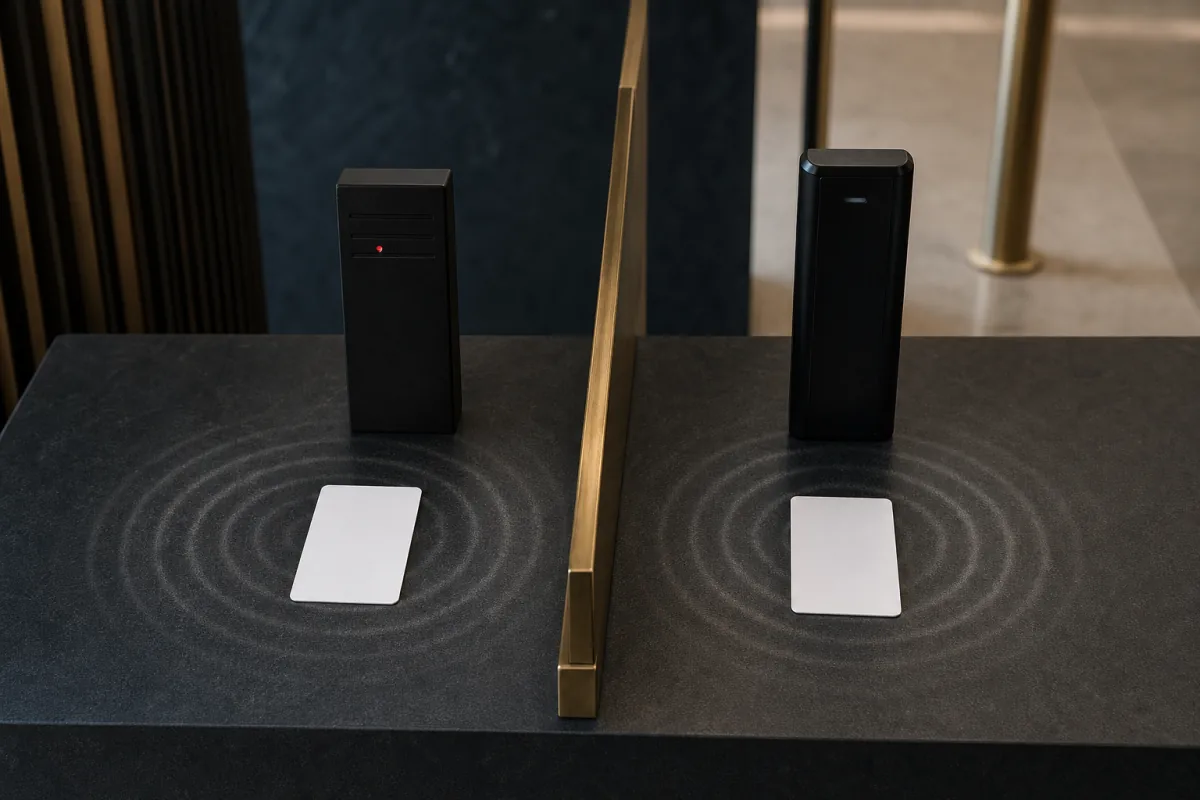
Indala FlexPass and HID Prox cards both operate at 125 kHz — and they are completely incompatible with each other. The reason is modulation: Indala uses PSK (Phase Shift Keying) encoding at the radio layer, while HID Prox uses ASK/FSK encoding. Swapping one for the other will not work, regardless of which direction you try it. American Key Cards manufactures a compatible Indala FlexPass 26-bit card and key fob, programmed to your exact facility code and card numbers.
Why the Same Frequency Does Not Mean the Same Format
The 125 kHz carrier is the first thing both formats share. It is also where the similarity ends.
Radio frequency tells you how fast the electromagnetic carrier wave oscillates. Modulation tells you how data is encoded onto that carrier. Two systems can share an identical carrier frequency and still be completely unable to read each other’s credentials, because the data encoding layer — the language the card uses to speak to the reader — is different.
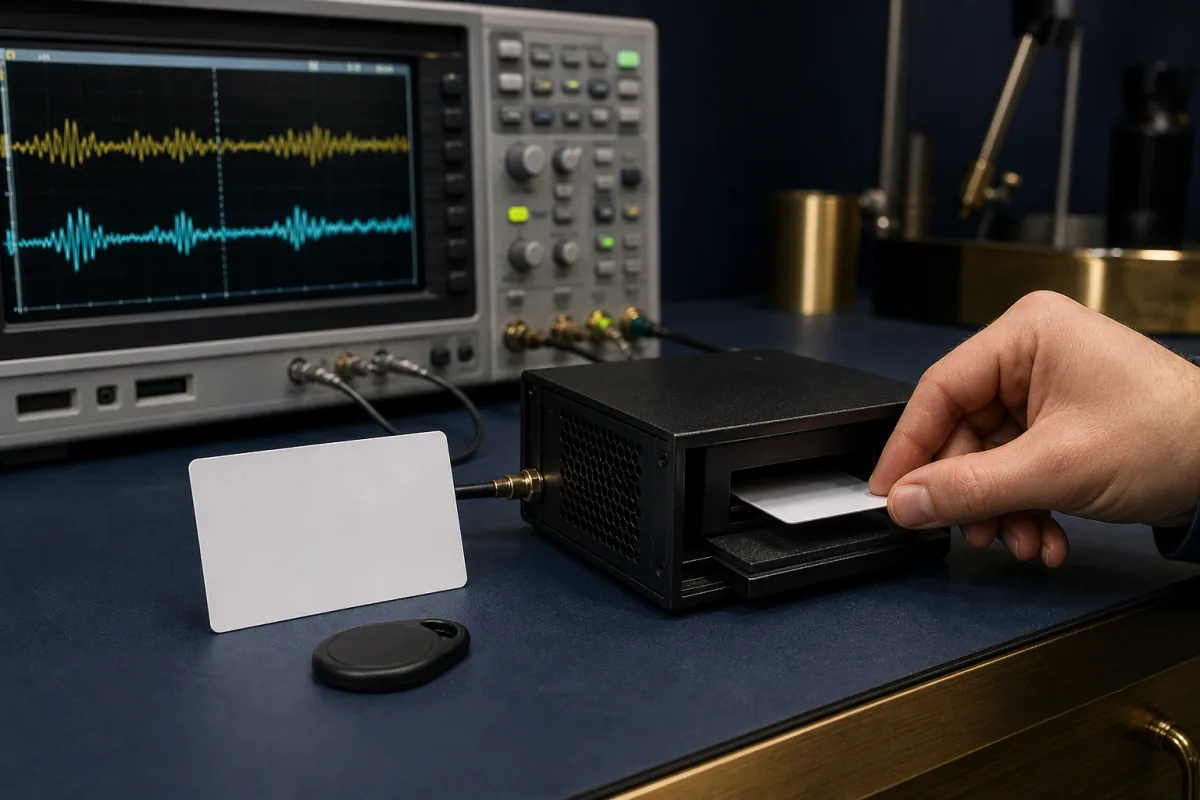
This is exactly the situation with Indala and HID Prox. Both run on 125 kHz. Indala uses PSK, which encodes data by shifting the phase of the carrier wave. HID Prox uses ASK (Amplitude Shift Keying) or FSK (Frequency Shift Keying), which encode data by varying amplitude or by switching between two slightly different frequencies. An Indala reader’s demodulator is built to decode phase shifts. When an HID card sends amplitude or frequency variations instead, the reader’s circuitry cannot interpret the signal and the card is ignored.
There is no configuration change, no reader setting, and no adapter that bridges this gap. They are different protocols.
Head-to-Head Specification Comparison
| Specification | Indala FlexPass 26-Bit | HID Prox H10301 (Standard 26-Bit) |
|---|---|---|
| Carrier frequency | 125 kHz | 125 kHz |
| Air-interface modulation | PSK (Phase Shift Keying) | ASK / FSK |
| Chip / transponder | Indala proprietary 172-bit PSK coil | HID Prox IC |
| Wiegand output to panel | 26-bit H10301-compatible | 26-bit H10301 |
| Facility code range | 1 – 255 | 0 – 255 |
| Card number range | 1 – 65,535 | 0 – 65,535 |
| OEM brand | HID Global / Motorola Indala | HID Global / ASSA ABLOY |
| OEM card part numbers | FPCRD-SSSMW-0000, FPISO-SSSCNA-0000 | 1386, 1326, 1346, 1586, 1336, 1391 |
| Compatible with the other’s readers? | No | No |
| Can be reproduced from facility/card number? | Yes (base card, no FlexSecur) | Yes |
| FlexSecur / encrypted variant available? | Yes (FlexSecur — not cloneable) | No (see Corporate 1000) |
| AKC compatible card available? | Yes — AKC Indala FlexPass 26-Bit Compatible Card | Yes — AKC HID Prox H10301 Compatible Card |
| AKC compatible fob available? | Yes — AKC Indala FlexPass 26-Bit Compatible Key Fob | Yes — AKC HID Prox H10301 Compatible Key Fob |
The single most important row in that table: the panel receives the same 26-bit Wiegand data stream either way. The incompatibility is entirely in the card-to-reader radio layer, not between the reader and the panel.
The Panel Does Not Care — The Reader Does
This distinction matters when troubleshooting. If someone orders the wrong card type — HID instead of Indala, or the reverse — the panel will never see any credential data at all. There is no partial read, no “wrong card” error code from the panel. The reader simply does not forward any data because it never successfully decoded the card. The door stays locked, the panel logs nothing, and the troubleshooting trail goes cold.
The fix is straightforward once you know: order a card that matches the reader’s format, not just the panel’s bit-length setting.
How to Identify Your Reader Format
Before ordering replacement cards, confirm which reader family is installed. Here is where to look:
Reader housing markings. Indala readers carry the Indala or HID Indala brand. Common Indala reader part numbers include FP4511A (mullion), FP3521A (surface mount), and the 603 and 610 series long-range models. HID readers carry the HID Global brand with product names like ProxPro, MiniProx, MaxiProx, ThinLine II, or ProxPoint Plus.
Your access control software. Many platforms record the reader model in the door configuration. Log into your panel management software and look at the hardware record for each door.
Installer documentation. The as-built documentation from the original installation will list reader make and model for every door. Property managers, facilities directors, and building engineers frequently have this on file.
Existing card labels. OEM Indala cards often carry part number references starting with FPCRD or FPISO. HID ProxCards and ISOProx II cards carry OEM part numbers beginning with 1326, 1386, or 1346. These are not always printed on the card face, but they appear in ordering documentation.
If you are still uncertain, contact us with a photo of the reader — we can usually identify the format from the reader housing alone.
Indala: A Brief History
Indala was developed under Motorola and operated as a distinct proximity card brand before HID Global acquired the product line. After acquisition, HID continued producing both Indala cards and readers under the “HID Indala” name. This history creates a specific confusion point: HID sells both HID Prox credentials and Indala FlexPass credentials, but the two product lines are not interchangeable, even within HID’s own catalog.
If your building manager says “we have HID cards,” that is not necessarily precise enough. You need to know whether the system uses HID Prox or HID Indala FlexPass — they require different cards.
The FlexSecur Variant: An Honest Assessment
Standard Indala FlexPass 26-bit cards carry no encryption. The 26-bit Wiegand data (facility code and card number) can be reproduced to produce a compatible credential — which is exactly how American Key Cards makes compatible cards. We manufacture cards to the same specification, programmed to your facility code and card number range. These are compatible credentials, not clones of any specific existing card.
Indala also produced a FlexSecur variant under the ASP product line. FlexSecur applies site-specific encryption between the card and reader. The encryption key is held by HID Global and is unique to each installation. Without that key, no third party — including American Key Cards — can manufacture working FlexSecur cards. If your installation uses Indala ASP / FlexSecur, replacement cards must come through HID Global. We say this plainly because we think buyers deserve an accurate answer.
Not sure which variant you have? Standard Indala readers (603, 610, FP4511A, FP3521A) read the unencrypted base cards. FlexSecur requires the ASP+ reader series. If your readers say ASP or ASP+ anywhere in the model designation, or if you know your installation required a special FlexSecur site-key programming step, you have the encrypted variant.
You can read more on the Indala ASP / FlexSecur format page or, if your system uses the extended facility code variant, our Indala 27-bit proximity card guide. For a deeper look at ordering the standard variant, see the Indala FlexPass 26-bit replacement guide; for the cloneability question specifically, can Indala FlexPass cards be cloned?
Ordering Compatible Indala 26-Bit Cards
For standard Indala FlexPass 26-bit installations, the ordering process is straightforward:
- Confirm your reader model (one of the Indala 603, 610, FP4511A, or FP3521A families, or a compatible equivalent).
- Identify your facility code — a number between 1 and 255.
- Identify the card number range you need programmed — each card gets a unique number between 1 and 65,535.
- Choose the form factor: clamshell card or key fob.
American Key Cards programs each card to your facility code and card number range before shipment. Cards arrive ready to enroll in your access control system — the same enrollment step you would use for any new credential. There are no OEM minimum order quantities and no dealer account requirement. We are not affiliated with HID Global or Motorola Indala; we manufacture compatible cards by specification.
Why Non-OEM Costs Less
Buyers on the Indala side of this comparison pay a specific penalty: FlexPass is a lower-volume line than mainstream HID Prox, so its OEM cards carry legacy-format pricing on top of the usual distributor margin. Neither the Indala card nor the HID card, though, contains anything you are actually paying a premium for — both are passive coils holding a plaintext facility code and card number, one in PSK and one in ASK/FSK.
That is why a programmed-to-spec card in either format costs less bought direct. We encode your facility code and card number onto the correct coil for your reader family, and it reads exactly as the OEM credential does. Just keep the two lines separate — an Indala card for an Indala reader, an HID Prox H10301 card for an HID reader — because they cannot substitute for each other across a single installation.
Ready to order? Contact us with your facility code, card number range, and reader model and we will confirm compatibility and provide a quote for Indala FlexPass 26-bit compatible cards or fobs.
Frequently asked questions
Can I use an HID ProxCard in an Indala reader?
No. Indala FlexPass readers use PSK (Phase Shift Keying) modulation to communicate with cards. HID Prox cards use ASK/FSK modulation. The two protocols are fundamentally incompatible at the radio layer, even though both operate at 125 kHz. An HID card placed on an Indala reader will not be recognized at all — the reader will ignore it completely.
How do I tell if I have an Indala reader or an HID reader?
Look at the reader housing. Indala readers will carry the Indala brand name or HID Indala branding — common models include the 603 FlexPass reader, 610 Mid-Range reader, FP4511A mullion reader, and FP3521A surface-mount reader. HID readers carry the HID Global brand and will reference ProxPro, MiniProx, MaxiProx, ProxPoint, or similar product names. If the reader is unmarked, check the original installer's documentation or the access control panel records.
Are Indala FlexPass 26-bit cards cloneable?
Standard Indala FlexPass 26-bit cards without the FlexSecur encryption layer can be reproduced from their facility code and card number. American Key Cards supplies compatible Indala 26-bit cards manufactured to specification — not clones of existing credentials. The FlexSecur variant uses a site-specific encryption key held by HID Global and cannot be duplicated by any third party, including AKC.
What information do I need before ordering Indala-compatible cards?
You need two things: your facility code (a number from 1 to 255) and the card number range you want programmed (1 to 65,535). Both are typically printed on your existing card label or recorded in your installer's documentation. If you are unsure, contact us and we can advise on how to identify them from an existing working credential.