Can DoorKing DKProx Cards Be Cloned? The Honest Answer
DoorKing DKProx cards run on the AWID 26-bit proximity protocol at 125 kHz with no cryptographic protection — which means the underlying credential data is technically reproducible. That said, the legitimate replacement path is ordering compatible cards programmed to your facility code, not cloning an existing card. American Key Cards supplies DKProx-compatible clamshell cards and key fobs encoded to your specification, available direct without a DoorKing dealer account.
What the DKProx Format Actually Is
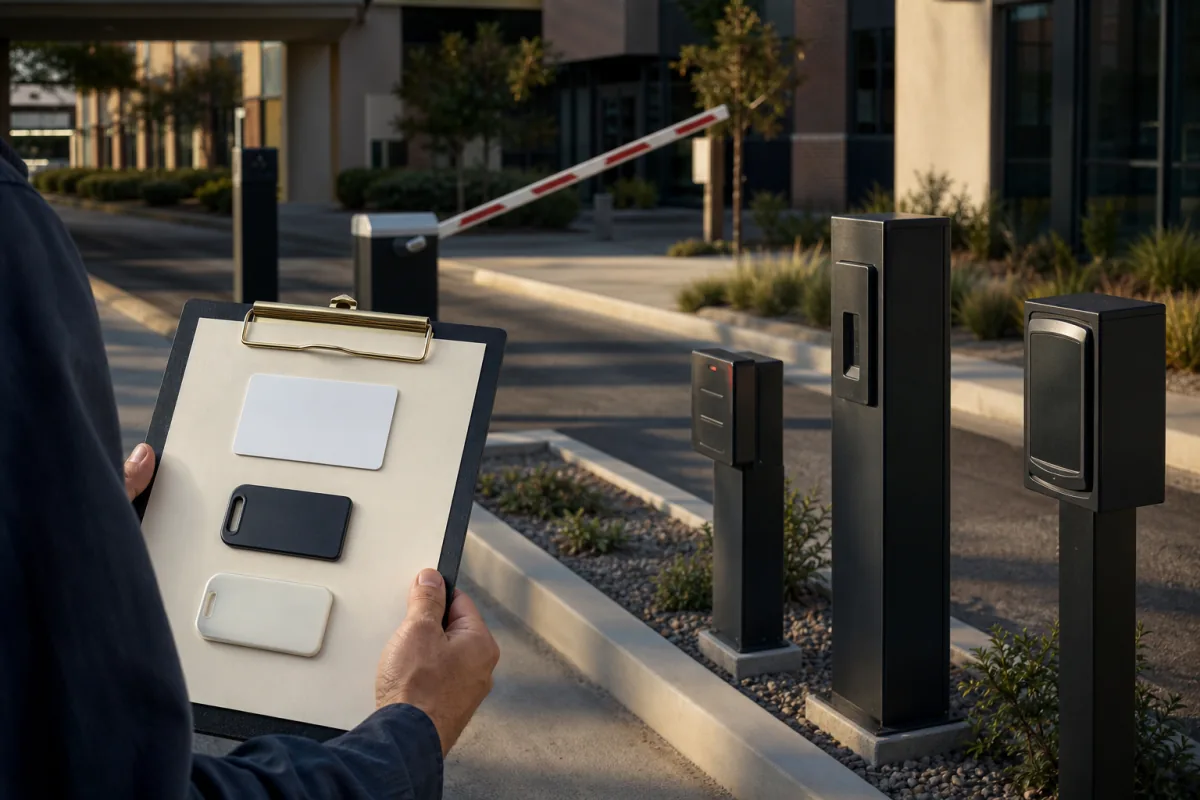
DoorKing’s DKProx system uses credential hardware from AWID (Applied Wireless Identifications Group). The OEM cards — part numbers 1508-120 (clamshell), 1508-121 (ISO printable), 1508-123, 1508-021, and the dual-technology 1508-198 — are all 125 kHz passive proximity credentials encoding data in the AWID 26-bit Wiegand format.
The Wiegand output to the access panel is standard: a facility code between 0 and 255, and a card number between 0 and 65,535, transmitted as a 26-bit data frame. This is the same data structure used by HID H10301 and many other proximity formats. The critical difference is in the card-to-reader RF encoding layer, which is AWID proprietary — and that is why an HID ProxCard II will not work in a DoorKing 1815-series reader even though both systems speak 26-bit Wiegand.
Reader Compatibility
DKProx-format credentials are designed for DoorKing’s 1815-series proximity readers:
1815-300,1815-301,1815-302(standard surface-mount proximity readers)1815-330,1815-331(alternate surface-mount variants)1815-282(DoorKing-branded AWID MM-6800 mullion reader)1815-281(DoorKing-branded AWID SP-6820 single-gang reader)1504-series intercom/proximity combination units
These readers are common on DoorKing 1830 and 1835 telephone entry systems at apartment complexes, gated communities, parking garages, and commercial facilities.
Can DKProx Cards Be Cloned?
The honest answer is yes — with a significant qualification.
DKProx credentials contain no encryption or challenge-response authentication. The card stores a facility code and a card number in a fixed format, and it broadcasts that data when it enters the reader’s RF field. A commercially available RFID duplicator (Proxmark3, ACR122U with appropriate software, or inexpensive 125 kHz copiers) can read that data off an existing DKProx card and write it to a blank T5577 writable transponder.
The resulting copy will function in a DKProx reader exactly as the original, because the reader has no way to distinguish between the OEM IC and a T5577 chip encoding the same data in the same format.
What Cloning Is Not the Same As
There is a meaningful difference between cloning an existing card and ordering a compatible replacement:
- Cloning copies the exact credential (facility code + card number) from an existing card onto a blank. This creates an unauthorized duplicate and, depending on jurisdiction and circumstances, may violate computer fraud statutes or property access laws.
- Compatible replacement means a supplier programs a new card with the specific facility code and card number you provide — credentials you legitimately own and manage for your property.
American Key Cards is not affiliated with DoorKing Inc. and operates independently. Our compatible cards are produced to match the AWID 26-bit specification by facility and card number; they are not made by copying existing credentials.
Why DKProx and HID Prox Are Not Interchangeable
The most common DKProx mistake is attempting to substitute standard HID ProxCards. Both formats operate at 125 kHz and deliver 26-bit Wiegand data to the access panel — but the physical-layer encoding is different.
| Feature | DoorKing DKProx | HID Prox (H10301) |
|---|---|---|
| Frequency | 125 kHz | 125 kHz |
| Air-interface encoding | AWID proprietary | HID FSK proprietary |
| Wiegand output | 26-bit (facility 0–255, card 0–65,535) | 26-bit (facility 0–255, card 0–65,535) |
| OEM part numbers | 1508-120, 1508-121, 1508-123 | 1326LGGMN, 1386LGGMN |
| Chip type | AWID 125 kHz IC | HID Prox IC |
| Interchangeable? | No | No |
| Cloneable? | Yes (no encryption) | Yes (no encryption) |
An HID card presented to a DKProx reader will simply not be detected. Similarly, a DKProx card presented to a standard HID reader will not respond. The two formats are related to the AWID 26-bit format used in standalone AWID reader installations, but both differ from standard HID H10301 Wiegand at the RF layer. HID Prox sits in the same unencrypted 125 kHz category, and the parallel question of whether HID Prox cards can be cloned reaches the same technical conclusion. If you are choosing a format for a new gate rather than replacing cards, our comparison of AWID vs. DoorKing vs. HID at the gate covers the trade-offs.
How to Identify Your DKProx System
You do not need to be a technician to confirm you have DKProx readers. Look for any of the following:
- The reader housing shows a DoorKing logo or the text “DKProx”
- The model number on the reader is
1815-2XXor1815-3XX - Your system is a DoorKing 1830 or 1835 telephone entry system
- Your existing cards are labeled
1508-120or1508-121 - Your access panel is a DoorKing 1802 or 1837 controller
If you are unsure, photograph the reader label and the back of an existing card and send both to our contact page — we can confirm the format before you order.
Ordering Compatible DKProx Replacements
Because DoorKing’s OEM cards are available only through the dealer network — with no online ordering, no small-quantity purchase, and dealer markup applied — property managers frequently face delays and higher costs when replacing lost or damaged credentials.
American Key Cards supplies AWID-format DKProx-compatible credentials directly:
- Card format: AKC DoorKing DKProx-Compatible Clamshell Card (AWID 26-bit, 125 kHz)
- Fob format: AKC DoorKing DKProx-Compatible Key Fob (AWID 26-bit, 125 kHz)
- Programming: Each unit encoded to your facility code and card number before shipping
- Quantity: No OEM-style minimum order
To place an order, provide your facility code and the card number or card number range you need. If you are adding new residents or employees, you simply specify unused numbers from your assigned range. If you are replacing a lost card, provide the original card number so the replacement inherits the same access rights in your panel. For the full ordering reference — part-number equivalents and form factors — see our DoorKing DKProx compatible cards guide.
What “Compatible by Specification” Means
American Key Cards produces credentials that match the AWID 26-bit specification — the same electrical and encoding characteristics as the OEM 1508-120 and 1508-121. We are not affiliated with DoorKing Inc. or AWID. “Compatible by specification” means the card will be read identically by your 1815-series DKProx reader and output the same Wiegand data to your access panel. Your panel and software do not distinguish between an OEM-issued card and an AKC-issued card with the same facility code and card number.
What makes this possible is specific to DKProx: the format publishes nothing more than a facility code and a card number over the AWID air interface, with no proprietary cryptographic lock that would gate who can produce a matching card. DoorKing’s control over the credential is a dealer-channel arrangement, not a technical one. Meet the AWID 26-bit spec and program the right facility code, and the 1815-series reader treats the card as its own.
What About More Secure Alternatives?
DKProx’s lack of encryption is a real limitation for security-sensitive deployments. If a physical copy of a resident’s card is made without authorization, the system has no mechanism to detect the duplicate.
Practical mitigations available within a DoorKing system:
- Enroll each card number individually and disable lost cards promptly through the 1802/1837 controller software
- Limit the number of active card numbers to the actual population (avoid pre-programming large batches)
- Use DoorKing’s telephone entry logging to audit access events by credential
DoorKing also offers 1508-198 dual-technology cards that combine DKProx and UHF RFID — useful for installations combining pedestrian and vehicle access — but neither technology layer adds cryptographic protection.
For environments where clone resistance is a firm requirement, this typically means moving to a 13.56 MHz smart card system with challenge-response authentication. DKProx is a 125 kHz legacy format and is correctly understood as such.
Ready to Order Compatible DKProx Cards?
If you manage a DoorKing gate or entry system and need to replace lost cards, issue credentials to new residents, or build a standing inventory, American Key Cards ships AWID-format DKProx-compatible cards and fobs programmed to your facility code.
Contact us at americankeycards.com/contact/ with your facility code, card number range, and quantity. We will confirm the format, program the cards, and ship direct — no dealer account, no OEM minimums.
Frequently asked questions
Can DoorKing DKProx cards be cloned?
Yes, technically. DKProx uses the AWID 26-bit proximity protocol at 125 kHz with no encryption, which means card data can be read and written to a blank T5577 transponder using commercially available RFID duplicator tools. However, a cloned card is an unauthorized copy of an existing credential. The legitimate path is ordering compatible programmed replacements from a supplier like American Key Cards — same result, properly issued.
Why won't a standard HID card work in my DoorKing reader?
DKProx readers use the AWID air-interface protocol, which is distinct from HID's H10301 protocol even though both operate at 125 kHz and output standard 26-bit Wiegand to the access panel. The RF encoding layer is different enough that an HID ProxCard II will not be recognized by a DoorKing 1815-series reader. You need credentials in AWID format, which is what DoorKing's `1508-120` and `1508-121` cards are.
What information do I need to order DKProx-compatible replacement cards?
You need your facility code (0–255) and the card numbers you want assigned (0–65,535). Both are printed on existing working cards or are available from the original installer's records or your access control panel log. American Key Cards programs each card to your exact facility and card number before shipping.
Are DoorKing cards sold outside the dealer network?
OEM cards — the `1508-120`, `1508-121`, and related part numbers from DoorKing Inc. — are sold only through DoorKing's authorized dealer channel. Compatible-by-specification alternatives, like those supplied by American Key Cards, are available direct with no dealer account required and no minimum order quantity.