DoorKing DKProx Compatible Cards: Skip the Dealer
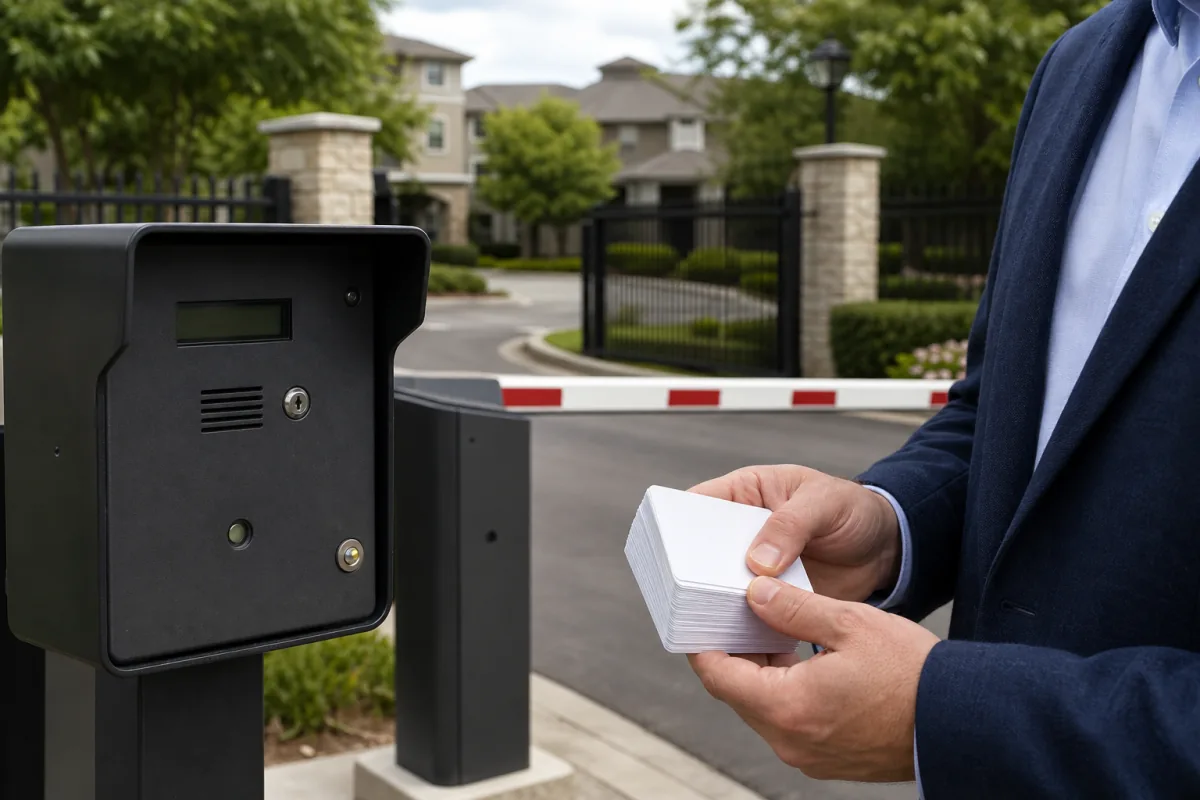
One fact saves most DoorKing owners a wasted order: DKProx readers speak the AWID protocol, not HID, so a standard HID proximity card will never read at a DoorKing gate no matter how it is programmed. American Key Cards supplies AWID-format DKProx-compatible clamshell cards and key fobs directly — no dealer account, no minimum order contact required — programmed to your facility code and card number range.
What Is DKProx and Why Does It Matter?
DoorKing (also known as DKS) is one of the most widely installed access control brands in residential gate systems across North America. Their DKProx credential line — the 1508 series cards and fobs — powers entry at apartment communities, gated neighborhoods, HOA gates, and parking facilities.
The DKProx format operates at 125 kHz using the AWID (Applied Wireless Identifications Group) air-interface protocol. This is a 26-bit Wiegand format, meaning the reader sends a standard 26-bit data stream to the access panel — the same structure used by HID, Indala, and dozens of other manufacturers. The key difference is at the radio layer: AWID encoding is proprietary and incompatible with HID’s H10301 encoding, even though the electrical output from reader to panel is identical.
In plain terms: the panel sees a “26-bit card” regardless of brand, but the reader will only talk to cards using its own protocol. Put an HID ProxCard in front of a DKProx reader and nothing happens.
DoorKing OEM Part Numbers
DoorKing sells DKProx credentials exclusively through its authorized dealer network. The OEM part numbers for the 1508 series are:
| OEM Part Number | Form Factor | Notes |
|---|---|---|
1508-120 | Clamshell proximity card | Standard replacement card, most common |
1508-121 | ISO graphics printable card | Printable surface for photo ID or branding |
1508-123 | Alternate clamshell variant | Same encoding, different body sourcing |
1508-021 | Older-series proximity card | Compatible with same DKProx readers |
1508-198 | Dual DKProx / UHF card | Long-range UHF + proximity in one card |
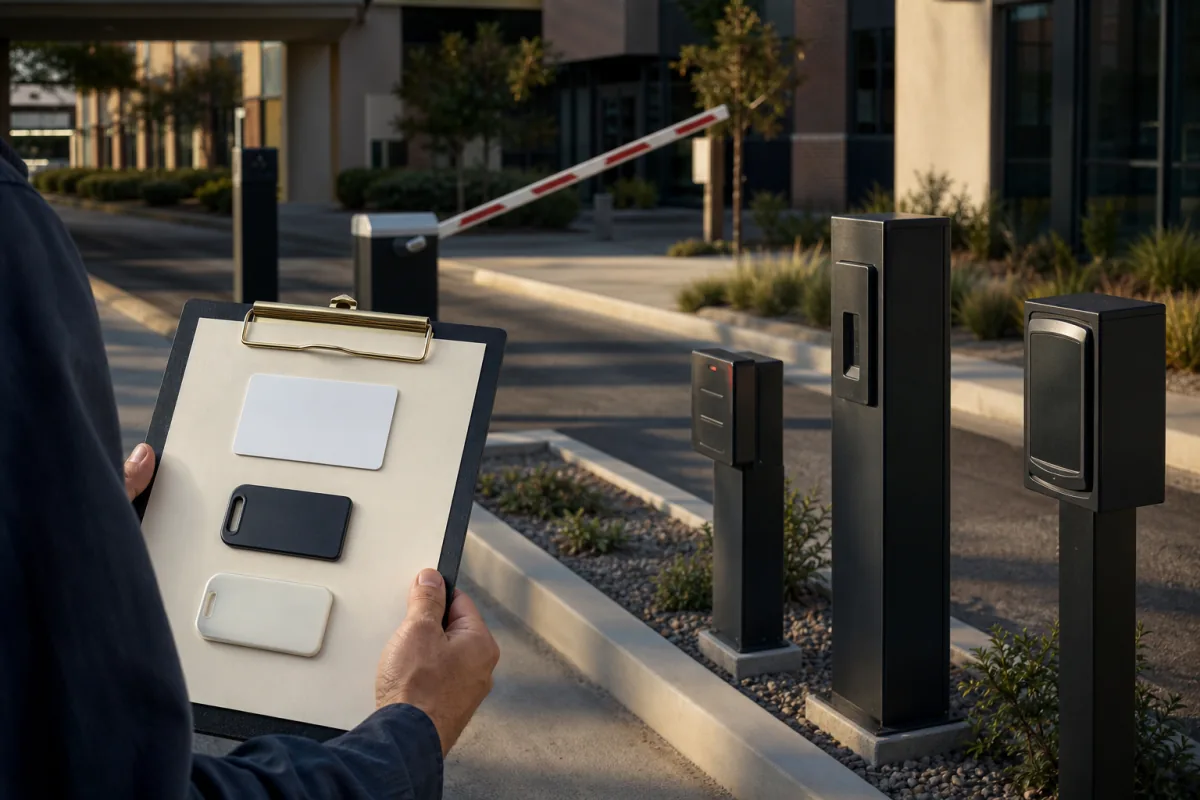
AKC’s compatible cards match the 1508-120 clamshell specification and the 1508-121 ISO card specification. They use the same AWID-protocol 125 kHz encoding, the same 26-bit Wiegand data output, and work with the same DoorKing 1815-series readers.
Which Readers Use DKProx Format?
The DKProx format is used across the DoorKing 1815 reader family and several OEM-labeled AWID readers installed under DoorKing system contracts:
- DoorKing 1815-300, 1815-301, and 1815-302 DKProx proximity readers
- DoorKing 1815-330 and 1815-331 surface-mount DKProx readers
- DoorKing 1815-282 (an OEM-labeled
AWID MM-6800mullion reader) - DoorKing 1815-281 (an OEM-labeled
AWID SP-6820proximity reader) - DoorKing 1504-series proximity reader/intercom combinations
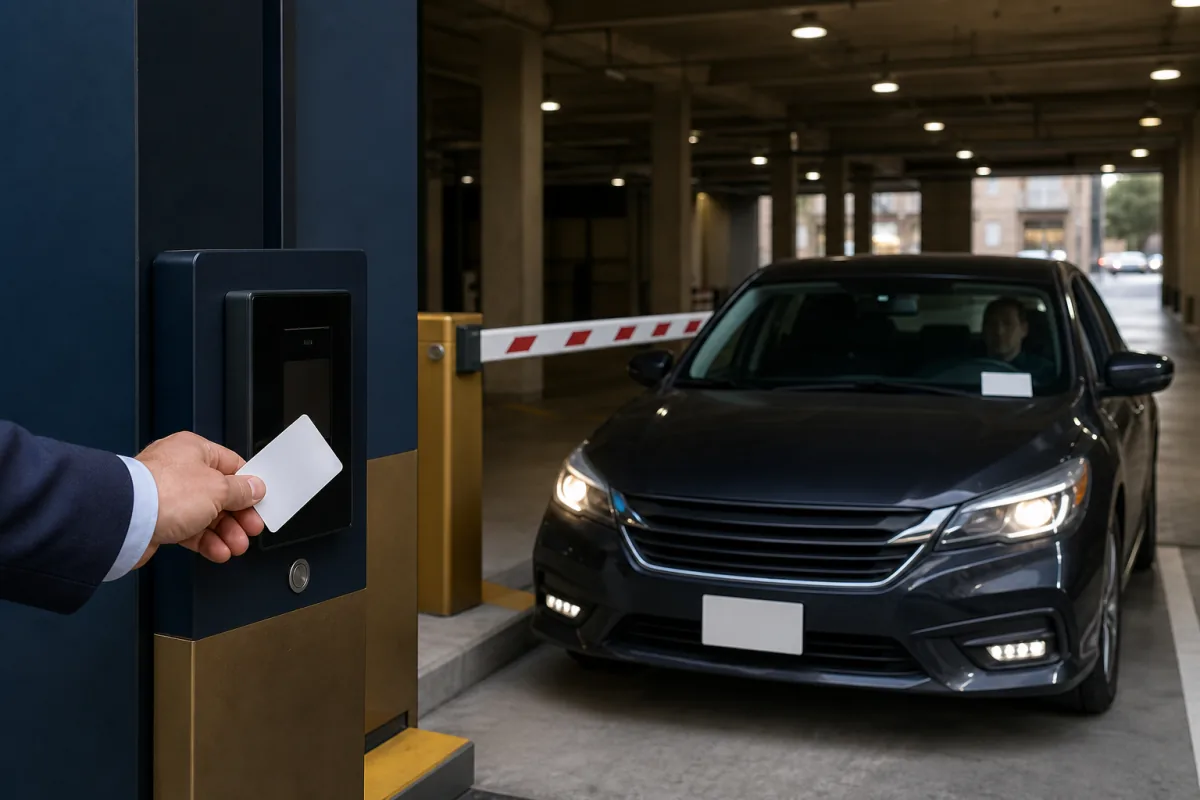
If you see any of those model numbers on the reader at your gate or door panel, your system uses DKProx format and requires AWID-protocol cards. The readers are typically mounted on a post or pedestal at vehicle gates, or on a wall plate at pedestrian entrances.
How to Identify Your Facility Code
Every DKProx card carries a facility code (0–255) and a card number (0–65,535) encoded at manufacture. These two numbers together form the credential that the access panel looks up when granting or denying entry.
To find your facility code:
- Look at your existing card. The facility code and card number are often printed on the card face or the back label, sometimes alongside a barcode or sequential number.
- Check the original installer records. DoorKing dealers document the facility code when the system is commissioned. If you have a management contract with the installer, they should have this on file.
- Contact your access panel. Property management software connected to DoorKing 1835 or 1830 controllers will show the encoded facility code in the credential database.
- Read an existing card with a scanner. An RFID reader tool that supports AWID format can read the card data directly.
If you cannot locate your facility code, contact us and we can advise on methods to recover it before you place a card order.
DKProx vs. Standard HID 26-Bit: Key Differences
A common mistake is ordering standard HID 26-bit cards for a DoorKing system. Both formats output 26-bit Wiegand data, but they are incompatible at the reader level.
| Property | DoorKing DKProx (AWID) | Standard HID H10301 |
|---|---|---|
| Frequency | 125 kHz | 125 kHz |
| Air interface protocol | AWID proprietary | HID proprietary |
| Bit format | 26-bit Wiegand | 26-bit Wiegand |
| Facility code range | 0–255 | 0–255 |
| Card number range | 0–65,535 | 0–65,535 |
| Works in DKProx reader | Yes | No |
| Works in HID ProxPro reader | No | Yes |
| Cloneable | Yes | Yes |
For more on why these two 26-bit formats are not interchangeable, see our AWID 26-bit format guide and our standard HID H10301 format guide. If your gate estate mixes DoorKing readers with HID or AWID hardware at different entrances, our comparison of AWID vs DoorKing vs HID for gate systems walks through how to tell which credential each barrier expects.
Can DKProx Cards Be Cloned?
Yes. The DKProx format uses the AWID 125 kHz proximity protocol with no encryption layer. The facility code and card number are stored in plain form on the card’s IC and can be read with commercially available RFID tools. A blank T5577 chip programmed with the AWID encoding and the correct facility code and card number will function in a DKProx reader.
This is the same security situation as standard HID 26-bit or EM4100 cards. The format’s age and widespread deployment mean it was designed in an era when cryptographic protection of access credentials was not standard practice.
For property managers, this means two things. First, it is the reason that aftermarket suppliers like American Key Cards can produce fully functional compatible cards from the facility code and card number alone — there are no encryption keys to negotiate. Second, it is worth knowing that an employee or tenant who had access to a card reader tool could theoretically clone a DKProx card. For higher-security environments, DoorKing does offer UHF long-range credentials and integrated intercom systems with additional authentication layers.
For the majority of apartment gates, parking structures, and gated community entry points, DKProx 26-bit has been the industry standard for decades and remains fully serviceable. If cloning risk at your property is a specific concern, our detailed look at whether DoorKing DKProx cards can be cloned covers the threat model in full, and HOA boards weighing a reorder will find the practical steps in our HOA gate access card replacement guide.
Why OEM DoorKing Cards Are Hard to Get
DoorKing distributes its 1508-120 and 1508-121 cards exclusively through its authorized dealer channel. End users — property managers, HOA boards, building owners — are not able to purchase cards directly from DoorKing. Dealers set their own pricing, require relationships or accounts, and often impose minimum order quantities that don’t fit small-batch replacement needs.
This is a deliberate distribution strategy, not a technical barrier. The DKProx format itself is not proprietary in the sense of being locked with encryption keys. Any supplier with the ability to program AWID-format 125 kHz credentials can produce cards that work identically to the OEM product.
American Key Cards is not affiliated with DoorKing Inc. or DKS. We produce compatible cards by specification — meaning our cards are encoded to the same AWID 26-bit protocol and 125 kHz frequency, programmed to your facility code and card number range, and ship ready for enrollment in your DoorKing system. The card body is a standard ISO clamshell or key fob — the same form factors as the OEM product.
What Information to Have Ready When Ordering
Before placing an order for DKProx-compatible cards or fobs, have the following ready:
- Your facility code (0–255)
- The starting card number and quantity you need (card numbers 0–65,535)
- Whether you need clamshell cards, ISO printable cards, or key fobs
- Any sequential numbering or labeling requirements for the card face
AKC programs cards in batches. If you need sequential card numbers (e.g., cards 101 through 150 with your facility code printed on the label), specify that in your order inquiry and we will accommodate it.
Why Choose Non-OEM DKProx Cards?
DoorKing’s 1508-120 and 1508-121 cards are dealer-only by policy, so a property manager who loses a handful of fobs is routed back through the installer, charged a low-quantity markup, and sometimes held to a minimum order. The AWID chip inside those cards carries no encryption keys to license, which is exactly why the dealer restriction is a sales arrangement rather than a technical lock.
An AKC card is programmed to the same AWID 26-bit air interface and the same facility code and card number range, so the 1815-series reader hands identical Wiegand data to your DoorKing panel. The reader has no way to register the AWID chip as a “new” credential type — it decodes the protocol, not the supplier — so the card enrolls exactly as the original did.
Ready to Order?
If you manage a property with DoorKing DKProx readers and need replacement clamshell cards or key fobs, American Key Cards can ship programmed credentials directly to you. Have your facility code and card number range ready and contact us to place an order or request a quote. We also supply credentials for related formats including AWID 26-bit and standard 26-bit HID-compatible cards if your property has a mixed-reader installation.
Frequently asked questions
Why won't a standard HID card work in my DoorKing reader?
DoorKing DKProx readers use the AWID (Applied Wireless Identifications) 125 kHz air-interface protocol, which is entirely distinct from the HID H10301 protocol even though both output 26-bit Wiegand data to the panel. The radio communication between card and reader is different at the encoding level. An HID ProxCard placed in front of a DKProx reader will produce no read — you need an AWID-format card.
What DoorKing part numbers are compatible with AKC replacement cards?
American Key Cards supplies drop-in compatible replacements for the 1508-120 clamshell card and the 1508-121 ISO graphics card, both of which use the same DKProx 26-bit AWID encoding. Also compatible with 1508-123 and 1508-021. All variants operate at 125 kHz with facility code 0-255 and card number 0-65,535.
Can DoorKing DKProx cards be cloned or copied?
The DKProx format uses standard 125 kHz proximity technology with no cryptographic protection. The card's facility code and card number can be read and the credential reproduced using commercially available RFID tools. This is a property of the AWID 26-bit protocol, not something specific to DoorKing. It means replacement cards can be produced from known facility and card number data, which is exactly how AKC programs compatible cards to order.
What information do I need to order DKProx-compatible replacement cards?
You need your facility code (a number from 0 to 255) and the card number range you want programmed (0 to 65,535). Both values are typically printed on your existing cards or available from the original installer's documentation. AKC programs each card to your exact specification before shipping.