HOA Gate Access Card Replacement Guide
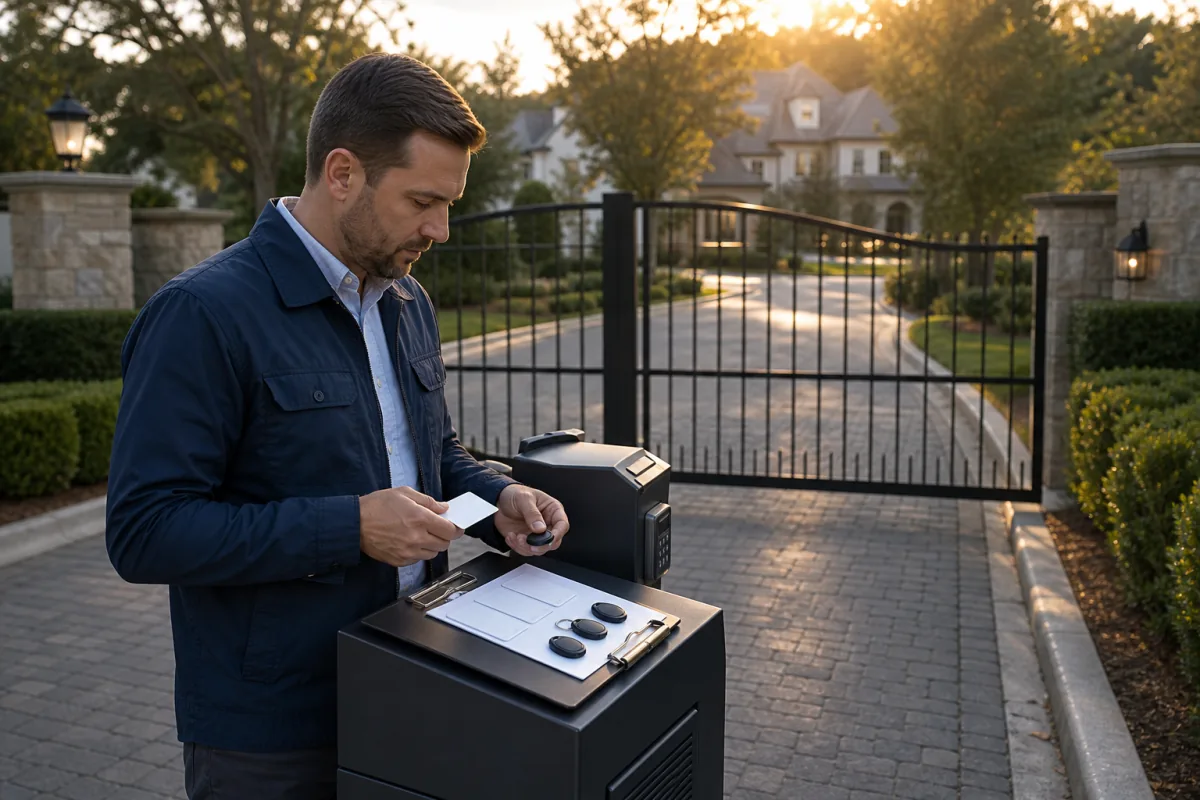
If your HOA or gated community uses a card or fob entry system, replacing lost credentials should not require calling the original gate company, waiting for a dealer quote, or paying elevated pricing. For the most common residential gate formats—standard 26-bit Wiegand and the distinct-air-interface 125 kHz proximity credentials that many gate readers use—American Key Cards supplies compatible cards and key fobs programmed to your facility code, shipped directly, with no dealer account required.
Why Gate Card Replacement Is Harder Than It Should Be
Residential gate systems are installed by access control contractors who typically specify one card format and source credentials through their own distribution channel. Once the installation is complete, the HOA board or property manager is left with a single reorder path: call the contractor, pay the markup, wait for delivery.
The underlying card technology in most residential gate systems is open, unencrypted 125 kHz proximity—the same technology available from multiple aftermarket suppliers. The perceived lock-in is a distribution arrangement, not a technical one. Understanding your format is the key to breaking out of the dealer cycle.
The Two Most Common HOA Gate Access Formats
125 kHz Proximity With a Distinct Air Interface
Many residential gate readers use a 125 kHz proximity credential whose card-to-reader air interface is different from the most common one. The critical technical point: both carry 26-bit Wiegand data to the access panel, but the RF encoding between the card and the reader is fundamentally different. A card built for the common air interface will not be read by one of these gate readers, and vice versa. This is the single most common ordering mistake in residential gate systems.
The reader housing almost always has the brand name and format designation visible, and the model number is the fastest way to confirm which air interface you are on.
American Key Cards supplies compatible clamshell cards and key fobs on this air interface, programmed to your facility code (0–255) and card number range (0–65,535). If a board member has raised security concerns, our piece on which access cards can and cannot be cloned addresses that directly.
Standard 26-Bit Wiegand (H10301)
A large share of residential and light-commercial gate controllers use the standard 26-bit H10301 Wiegand protocol—the same air interface as the most common building-access cards. Because these readers use standard encoding, any properly programmed 26-bit H10301 card will work.
American Key Cards supplies compatible 26-bit clamshell cards and key fobs for these gate installations, programmed to your facility code.
Other Standalone 125 kHz Gate Formats
Some communities have standalone reader installations that are not part of a larger brand ecosystem but use the same distinct 125 kHz air interface described above. The ordering process is identical—provide facility code and card number range, and AKC ships compatible credentials on the matching air interface. When a community runs a mix of gate readers across its entrances, our guide to identifying your access card format is the quickest way to match each reader to the right credential.
Format Comparison: Common HOA Gate Credentials
| Format type | Frequency | Structure | Cloneable | AKC compatible |
|---|---|---|---|---|
| 125 kHz proximity, distinct air interface | 125 kHz | 26-bit Wiegand output | Yes | Yes |
| Standard 26-bit (H10301) | 125 kHz | 26-bit H10301 | Yes | Yes |
| Extended / facility-code-less 125 kHz (37-bit H10302) | 125 kHz | 37-bit, no facility code | Yes | Yes |
| Encrypted 13.56 MHz smart card | 13.56 MHz | AES-encrypted | No | No |
Cloneability and Security: An Honest Assessment
Standard 125 kHz gate credentials are unencrypted proximity cards. This means they can be duplicated with commercially available tools—that is a factual characteristic of the underlying technology, not a flaw unique to aftermarket cards.
For the vast majority of HOA and gated community applications, this is an acceptable risk. The primary security need is restricting vehicle and pedestrian access to residents, not defending against sophisticated credential attacks. Communities that have experienced significant card fraud or require stronger access assurance should consult their gate installer about upgrading to an encrypted smart credential system.
What this means for AKC’s compatible cards: our credentials are not clones of existing cards. They are newly manufactured credentials, programmed to your facility code and issued card numbers—the same programming process used when the gate system was originally commissioned. The distinction matters: we program new cards to your specification, not copy existing ones.
Encrypted 13.56 MHz smart credentials that use AES cryptography cannot be cloned or sourced from any aftermarket supplier, including us. Those require re-enrollment through the original platform. If your community uses encrypted smart cards, this guide does not apply to your credential management.
How to Identify Your HOA Gate’s Card Format
Step 1: Find the reader model number. The reader mounted at your gate entry point almost always has the brand name and model visible on the housing. That model number usually maps directly to a format.
Step 2: Look at your existing cards. Many credentials print a part number directly on the card body, and the facility code is often labeled “FC,” “Site Code,” or “S/C” on the card face.
Step 3: Check the gate system documentation. The access panel installed in your gate control box—or the original installation paperwork—should identify the card format and the facility code used.
Step 4: Ask the original installer. If you have any relationship with the contractor who installed the gate, the facility code is in their records. Most installers will provide this to the property owner on request.
For more detail on format identification, see our guide on how to identify your access card format, and how to find your facility code once you know which format you are on.
What “Compatible by Specification” Means for Gate Cards
American Key Cards is not affiliated with any gate system manufacturer. Our cards and fobs are compatible by specification: they use the same 125 kHz frequency, the same air-interface protocol as your reader, and the same 26-bit Wiegand data structure as the credential they replace. They are programmed to the same facility code and card numbers.
What that means practically: when your resident presents our card at the gate reader, the reader decodes it, sends the standard Wiegand data to your access panel, and the gate opens—exactly as it would with the original card.
What it does not mean: we cannot reproduce credentials that use AES cryptographic protection. If your gate system uses encrypted smart cards, the platform controls credential issuance and we cannot help with those specific formats.
Why Non-OEM Gate Cards Cost Less
The gate contractor who commissioned your system is usually the only reorder path an HOA is handed, and that is the whole cost problem: the credential passes from manufacturer to regional distributor to that contractor, who marks it up a final time before it reaches the board. The chip inside a gate fob is a small 125 kHz transponder worth a fraction of the price at any step in that chain — the markup is the contractor relationship, not the part.
Because these formats are open Wiegand standards with no keys to license, AKC programs credentials to order and sells straight to the board or property manager, with no contractor margin in the line. Across 50 fobs at a move-in wave or a 200-card batch for a gate expansion, that per-unit gap adds up fast — and the gate reader cannot tell the difference, because it decodes the RF signal and the facility code, not the name printed on the card.
Ordering Compatible HOA Gate Cards and Fobs
The ordering process is straightforward:
- Identify your gate reader model (from the housing)
- Locate your facility code—on an existing card, in the gate system’s panel software, or in your installation records
- Decide on card number range for the new batch
- Choose clamshell card, key fob, or both
AKC programs each batch to your exact specification and ships ready-to-enroll credentials. No access panel reconfiguration is needed. New cards can be added to the gate system’s credential database exactly the same way as any other authorized card.
If you are unsure of your format or facility code, contact American Key Cards with your reader model number and any details from your existing cards or installation documentation. We will confirm the correct format and walk you through what information we need to program your order.
HOA boards and property managers who need to reorder gate access cards and fobs without going through the original installer can contact American Key Cards directly. Provide your gate reader model, facility code, and quantity, and we will program and ship compatible credentials to your address.
Frequently asked questions
What access card format do most HOA gate systems use?
The most common HOA gate credentials are 125 kHz proximity formats: standard 26-bit Wiegand (H10301) and other 125 kHz formats that use a distinct card-to-reader air interface. Your format depends on the reader installed at the gate—some readers use standard 26-bit encoding, others use a proprietary air interface even though both send 26-bit data to the panel. The reader model number on the housing is the fastest way to confirm which format you need.
Can I order HOA gate cards without going through the gate company or a dealer?
Yes. These are open 125 kHz proximity formats that can be supplied by aftermarket vendors. American Key Cards programs compatible clamshell cards and key fobs to your facility code and ships directly to the HOA board or property manager—no dealer account required.
What information do I need to order replacement gate cards for my HOA?
You need three things: your gate reader model (found on the reader housing), your facility code (sometimes called site code), and the card number range you want programmed. The facility code is usually on your existing cards or in the gate system's programming records. Contact us if you cannot locate it—we can often help identify the format from the reader model alone.
Can HOA gate fobs and cards be cloned, and is that a security concern?
Standard 125 kHz gate credentials operate without encryption and can be duplicated with commercially available RFID tools. For most HOA applications the primary concern is authorized reordering, not adversarial cloning. If your community requires higher security, encrypted 13.56 MHz smart credentials exist—but those cannot be sourced from aftermarket suppliers and must go through the original vendor's enrollment platform.