Low-frequency credentials
Standard 125 kHz proximity cards
Reliable passive 125 kHz cards and key tags for the low-frequency reader installations found across apartments, gated communities, offices and self-storage. We match the credential protocol, facility code and number range to the reader already at your facility — 125 kHz covers several incompatible protocols, so we verify before encoding.
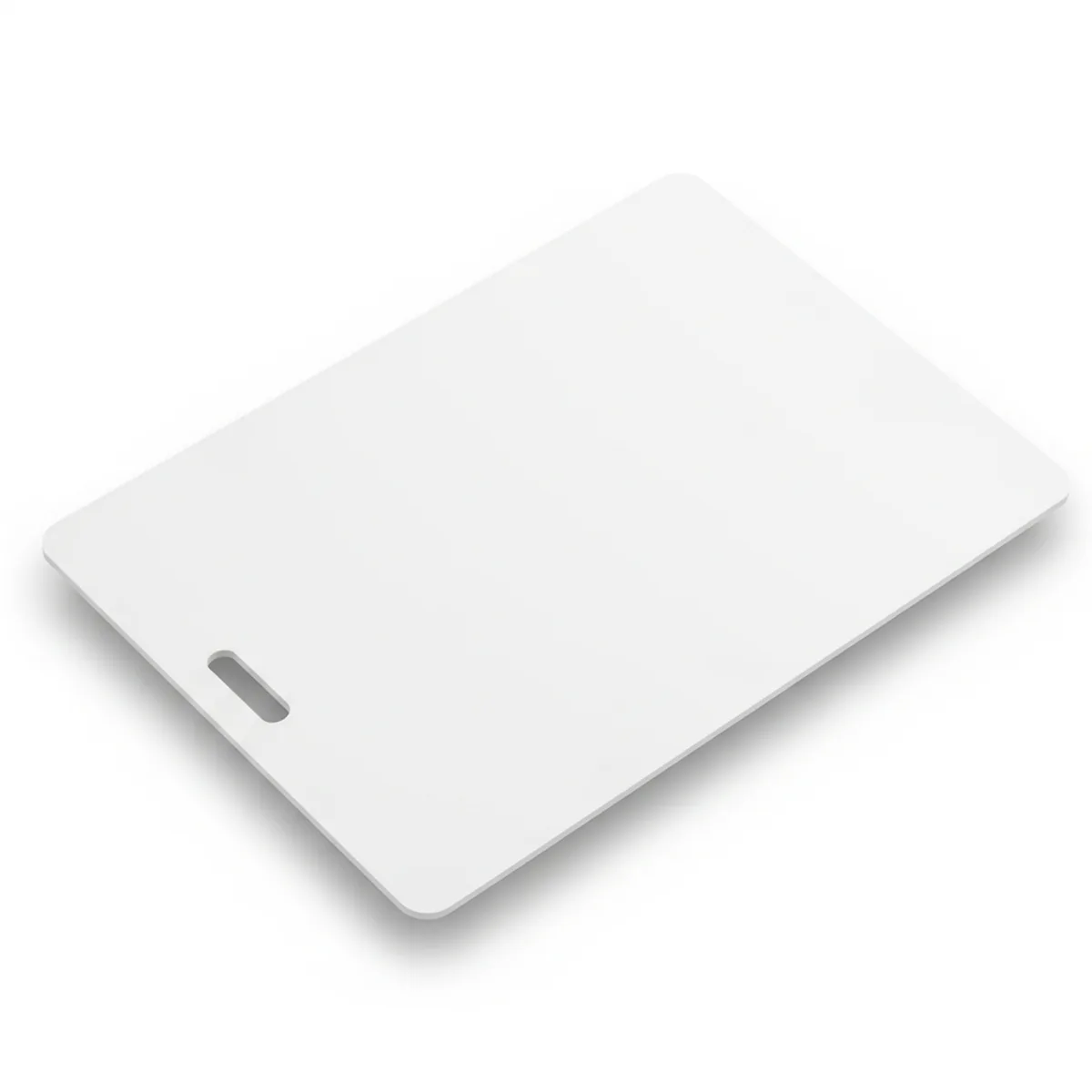
Available as a compatible-by-specification credential after we verify your reader and facility format.
What are standard 125 kHz proximity cards?
Standard 125 kHz proximity cards are passive low-frequency RFID credentials — most commonly EM4100, EM4102 or EM4200-compatible — carrying a factory-programmed 64-bit ID read at 2–6 inches. They come as clamshell cards, printable ISO cards and key fobs. American Key Cards encodes each batch to the number range your access panel expects, after verifying the RF protocol from a sample card or reader model, with no dealer account required.
Overview
About 125 kHz prox cards
Low-frequency 125 kHz proximity is still the most widely installed credential technology in American apartment buildings, self-storage facilities, small offices and gated communities. If your reader beeps when you present a thick clamshell card or a gray key fob, there is a very good chance it reads this family.
We supply EM-compatible cards, printable ISO cards and key fobs encoded to the number range your access panel expects, so new credentials drop straight into your existing software without re-enrolling every user at the door. Before production we confirm the RF protocol from a working sample or the reader model, because "125 kHz" alone covers several incompatible formats.
Technical details
Standard 125 kHz proximity cards specifications
- Frequency
- 125 kHz
- Technology
- Passive RFID proximity, read-only transponder
- Typical chip families
- EM4100 / EM4102 / EM4200-compatible
- ID structure
- 64-bit factory-programmed unique ID
- Card dimensions
- CR80 ISO/IEC 7810 ID-1 — 85.6 × 54 mm
- Thickness
- ISO card 30 mil / 0.76 mm; clamshell is a thicker rigid shell
- Typical read range
- 2–6 in (5–15 cm), reader-dependent
- Card material
- PVC (ISO card); ABS clamshell
- Printing
- ISO body runs through dye-sub direct-to-card printers
- Encoding
- Matched to the reader protocol and facility number range
Available configuration
Choose the form factor after the technology
Where it fits
Common 125 kHz prox cards applications
Apartment & multifamily buildings
Replacement fobs for tenants and bulk stock for property managers running EM-based intercom and entry panels.
Self-storage facilities
Gate and keypad-integrated proximity credentials numbered to match the facility management software.
Small offices
Low-cost door credentials for standalone readers where a full smart-card system would be overkill.
Gyms & clubs
Check-in cards and fobs for membership systems built on standard low-frequency readers.
Before you order
How to order 125 kHz prox cards correctly
- Confirm the protocol, not just the frequency
Several incompatible protocols all transmit at 125 kHz, and none of them read each other. Send us a working credential or the reader model and we verify the exact protocol before anything is encoded.
- Know your number range
Most panels enroll credentials by number. We encode sequentially from the range you give us so cards can be activated in your software without touching each unit.
- Pick the body for the job
Clamshells survive abuse and drilling for badge clips; printable ISO cards take dye-sub printing for photo IDs; fobs live on keyrings.
Questions we actually get
125 kHz prox cards FAQ
Will these cards work with my existing reader?
If your system reads EM4100/EM4102/EM4200-class credentials, yes. We confirm compatibility from a sample card, a clear photo of the reader, or the installer’s spec sheet before we produce anything.
Can you match my existing card numbers?
We encode new credentials into the number range you specify. If you send the numbering scheme printed on your current cards, we continue the sequence so your access software stays organized.
What is the minimum order?
Small replacement batches are fine — you do not need to order thousands. Pricing steps down at volume, so property groups ordering for multiple buildings see the best rates.
Are 125 kHz cards secure?
They are convenient rather than cryptographic — the technology dates from an era before encryption was standard. For most residential and low-risk commercial doors that trade-off is acceptable; where it is not, we will point you to our encrypted smart cards instead of overselling prox.
Need help identifying the technology?
Send a photo of the credential and the reader model. We'll identify the format before we quote a compatible product.
Lifetime parts & workmanship guarantee on every card