Hospital and Healthcare Facility Access Card Guide
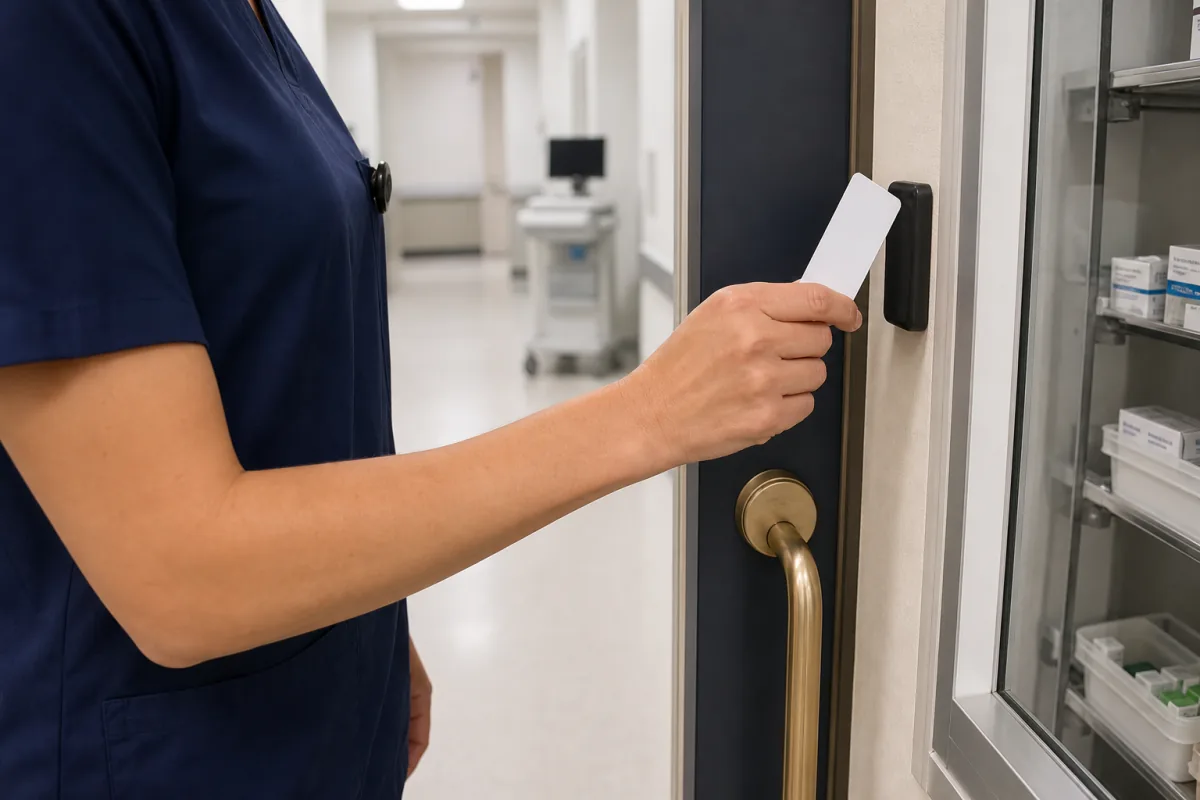
Hospitals and large healthcare campuses routinely run access control on standard 26-bit proximity, extended-security 125 kHz formats, enterprise 36-bit platforms, or 34-bit proximity systems—sometimes all four on the same campus. American Key Cards supplies compatible proximity cards and key fobs for the 125 kHz formats most common in healthcare, programmed to your facility code, with no OEM dealer account required. For encrypted 13.56 MHz smart card formats, no third party can supply functional replacements, and we say so plainly.
Why Healthcare Facilities Have Complex Access Control Environments
Health systems grow by acquisition and renovation rather than ground-up builds. The result is a patchwork: the cancer center installed in 2006 may run a 34-bit proximity system; the surgical wing renovated in 2014 runs encrypted 13.56 MHz smart cards; the administrative building still uses an extended-security 125 kHz format. A director of facilities may be managing credentials for three or four incompatible reader families at once.
Ordering the wrong card format is the single most costly mistake in hospital credential management—a card that looks identical to the correct one but encodes the wrong protocol will not read. This guide covers each major format, how to identify which one your facility uses, what to order, and which formats cannot be sourced from any third-party supplier.
Format 1: Standard 26-Bit Proximity (H10301)
Standard 26-bit Wiegand (H10301) is the most common single access card format in North American healthcare facilities. It operates at 125 kHz, carries no encryption, and transmits an 8-bit facility code (0–255) and a 16-bit card number (0–65,535) to the access panel.
It is supported by virtually every 125 kHz Wiegand reader on the market. American Key Cards supplies compatible H10301 cards and fobs programmed to your facility code.
For the products we can supply, see our full product range.
Security note: Standard 26-bit proximity cards are cloneable with widely available handheld duplicators. They are appropriate for general staff access and lower-security zones, not for pharmacy or areas where credential integrity is critical.
Format 2: Extended-Security 125 kHz Proximity
A second family of 125 kHz credentials common in mid-size hospitals and medical office buildings uses a dual-encoded format: a proprietary extended-security air interface with a 64-bit codebase supporting over 4 billion unique codes, plus a standard 26-bit Wiegand (H10301) output encoded on the same card simultaneously for backward compatibility.
American Key Cards supplies compatible cards and fobs in this format, dual-encoded with both the extended-security payload and the 26-bit Wiegand output—drop-in replacements without software reconfiguration.
Security note: This family operates at 125 kHz without encryption. The extended-security dual-encoding provides a larger code space than standard 26-bit but adds no cryptographic protection—these credentials remain cloneable, like all unencrypted 125 kHz formats.
Format 3: Enterprise Platforms (26-Bit and Extended 36-Bit)
Enterprise access control platforms are very common in large health systems and university medical centers. They typically support both standard 26-bit H10301 proximity cards and a proprietary 36-bit format.
The proprietary 36-bit format expands the facility code range from 0–255 (standard 26-bit) to 0–1023, which matters for large health systems with multiple campuses sharing a common credential infrastructure. The intelligent readers on these platforms accept both 26-bit and 36-bit formats; the system configuration determines which is active at each door.
American Key Cards supplies compatible cards and fobs for these systems in both formats. Let us know your panel model and facility code length so we can program the correct format.
Format 4: 34-Bit Proximity
A 34-bit proximity format is common in healthcare facilities running certain enterprise management platforms. It operates at 125 kHz with a 34-bit Wiegand frame, supporting facility codes and card numbers each from 0 to 65,535—a much larger space than standard 26-bit’s shared facility code constraint.
American Key Cards programs compatible 34-bit cards and fobs in ISO PVC and clamshell form factors. You will need your facility code and card number range from your management software or installer documentation.
Format 5: Encrypted 13.56 MHz Smart Cards — What No Third Party Can Supply
Many hospitals and health systems deploy encrypted 13.56 MHz smart cards on higher-security areas: pharmacy, controlled substance storage, data centers, and anywhere HIPAA-driven audit trails require verified identity.
These credentials operate at 13.56 MHz with AES-128 encryption and digitally signed credential data cryptographically bound to the specific card chip. There is no publicly known successful cloning attack against a properly configured encrypted 13.56 MHz smart card.
American Key Cards cannot supply functional encrypted 13.56 MHz smart card replacements—and neither can any other third-party supplier. Replacements require re-enrollment through your system integrator using the platform’s secure issuance infrastructure. We include this clearly because healthcare security managers ask often, and accurate information matters more than a sale we cannot make.
Comparison: Common Healthcare Access Card Formats
| Format | Frequency | Structure | Facility Code Range | Cloneable | AKC Can Supply |
|---|---|---|---|---|---|
| Standard 26-bit (H10301) | 125 kHz | 26-bit Wiegand | 0–255 | Yes | Yes |
| Extended-security 125 kHz | 125 kHz | Dual-encoded + 26-bit | 4+ billion codes | Yes | Yes |
| Enterprise 26-bit | 125 kHz | 26-bit Wiegand | 0–255 | Yes | Yes |
| Enterprise 36-bit | 125 kHz | 36-bit Wiegand | 0–1023 | Yes | Yes |
| 34-bit proximity | 125 kHz | 34-bit Wiegand | 0–65,535 | Yes | Yes |
| Encrypted 13.56 MHz smart card | 13.56 MHz | AES mutual authentication | N/A (encrypted) | No | No |
How to Identify Your Healthcare Facility’s Card Format
Start with an existing card label. Most cards print a facility code and card number sequence on the body. Your access control software will list the credential type for any enrolled cardholder, which is the most reliable source.
If your card labels are worn or unlabeled, our walkthrough on how to identify your access card format covers reader-housing markings and software checks, and how to find your facility code shows where the site code lives in common management platforms.
If you have only the reader model number, contact us at /contact/. We can usually identify the format from the model alone.
Ordering Compatible Healthcare Access Cards
For any 125 kHz proximity format in the table above, you need four things: your format name, your facility code, your desired card number range, and quantity and form factor (ISO PVC card, clamshell, or key fob).
American Key Cards is a U.S. supplier of compatible-by-specification access credentials. Our cards are not OEM products and are not affiliated with any reader or platform manufacturer. They are programmed to the same format specification as the OEM card, using the facility code and card number you provide, and they work in the same readers. There are no OEM-channel minimums and no dealer account required.
To get started, reach out through the contact page with your format and facility code details. We will confirm availability, programming specs, and lead time before you commit to an order.
Frequently asked questions
What access card formats are most common in hospitals?
The most frequently deployed formats in U.S. healthcare settings are standard 26-bit proximity (H10301), an extended-security 125 kHz format, an enterprise platform running either standard 26-bit or a proprietary 36-bit format, and a 34-bit proximity format. Many larger health systems also deploy encrypted 13.56 MHz smart cards on sensitive areas. The format in your facility depends on who installed the system and which access control platform your security team manages.
Can third-party suppliers replace encrypted 13.56 MHz smart cards used in hospitals?
No. Encrypted 13.56 MHz smart cards use AES encryption with digitally signed credential data cryptographically bound to the specific card chip. No third party can clone, reproduce, or supply functional replacements for these cards. Replacements require re-enrollment through your system integrator using the platform's issuance infrastructure. American Key Cards does not claim otherwise, and we will tell you clearly when a format is outside what we can supply.
What information do I need to order compatible hospital access cards?
For standard 125 kHz proximity formats, you need your facility code (sometimes called site code), the card number range you want programmed, and your reader brand and model. This information is typically on your existing card labels, in your access control software, or in the installer's commissioning records. Contact us if you cannot locate it—we can often identify the format from the reader model number.
Are standard 125 kHz proximity cards secure enough for a hospital environment?
Standard 125 kHz proximity cards carry no encryption and can be cloned with commercially available tools. For general staff and visitor access in lower-risk zones, 125 kHz credentials are widely accepted in healthcare. For pharmacy, server rooms, executive areas, or anywhere HIPAA audit trails are required, most health system security teams deploy encrypted 13.56 MHz smart cards, which cannot be cloned. AKC supplies compatible cards for the 125 kHz formats; we advise clients honestly when upgrading to smart card technology is the right answer.