Farpointe Pyramid PSC-1 Card Replacement Without a Dealer
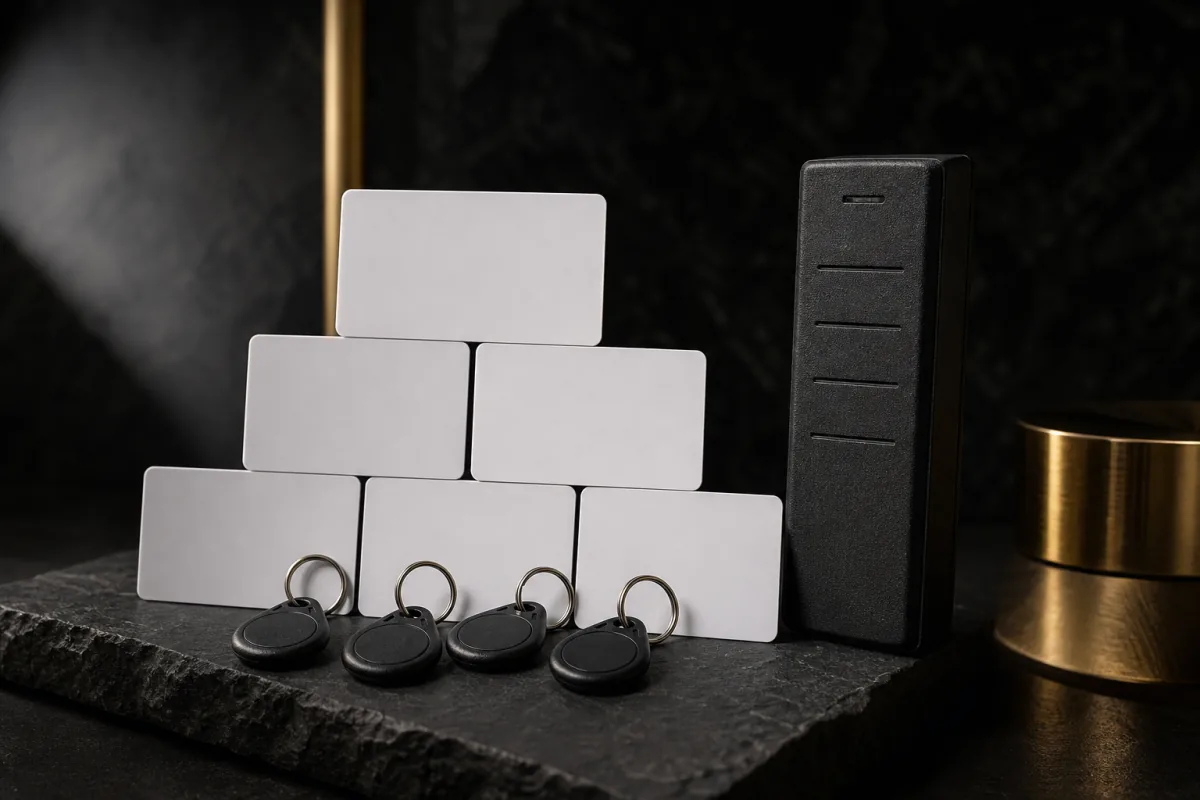
If you manage a building or facility running Farpointe Pyramid Series readers, you can replace lost or expired PSC-1 cards and PSK-3 key fobs without going through a Farpointe-authorized dealer. American Key Cards supplies compatible 125 kHz proximity credentials programmed to your facility code in any quantity — no minimum order, no dealer registration required. The Pyramid Series uses standard 26-bit Wiegand (H10301) encoding, meaning a compatible card matched to your facility code and card number will read identically to the OEM credential on your existing readers.
What Is the Farpointe Pyramid Series?
Farpointe Data’s Pyramid Series is one of North America’s most widely deployed OEM proximity card platforms. It is used extensively in corporate campuses, institutional access control, and in systems manufactured under the Dormakaba and Keyscan brands. Farpointe positions the Pyramid line as a certified, channel-only credential — but the underlying technology is standard 125 kHz passive proximity, the same class of credential used by HID ProxCard II, AWID, and numerous other brands.
Pyramid credentials are factory-encoded read-only cards. They power up inductively from the reader’s RF field, transmit their stored data, and are decoded by the reader’s Wiegand output circuit. There is no active processing or on-card encryption — the security boundary is the reader and the access panel, not the card itself.
Frequency, Chip, and Bit Formats
| Specification | Detail |
|---|---|
| Frequency | 125 kHz passive proximity |
| Chip | Farpointe Pyramid proprietary 125 kHz IC; factory-encoded, read-only |
| Primary bit format | 26-bit Wiegand (H10301) — facility code 0–255, card number 0–65,535 |
| Native format | 39-bit Pyramid proprietary (native Pyramid encoding, less common) |
| Also available | 37-bit H10304 Corby format; HID-compatible variants (-H suffix part numbers) |
| Anti-skimming | MAXSecure in Pyramid reader hardware — does not affect card data security |
| Read range | Up to 8 inches (PSC-1 clamshell form factor) |
| Cloneable | Yes — no cryptographic protection at the card level |
The MAXSecure feature is worth clarifying: it is a reader-side function designed to reduce passive eavesdropping range, not an encryption layer on the card. The card itself stores its data in plain, readable form.
OEM Part Numbers to Know
Farpointe’s Pyramid credential line spans several form factors, each with its own part number. The most common ones you will see on card labels or in installer documentation:
PSC-1— standard clamshell card (the most common form factor)PSC-1-H— HID-compatible variant of the PSC-1 clamshellPSC-1-A— alternate version with different housingPSI-4— printable dye-sublimation ISO card for photo-ID applicationsPSI-4-H— HID-compatible ISO printable cardPSM-2P/PSM-2S— multi-technology card variantsPSK-3— key ring fob (the standard key fob SKU)PSK-3-H— HID-compatible key ring fobPDT-1— disc tag form factor
The -H suffix indicates HID-compatible encoding, meaning these variants will also read on standard HID Prox readers. If your readers are Farpointe P-series, the standard variants without the -H suffix are appropriate.
How to Identify Your System Is Using Pyramid Cards
Before ordering replacements, confirm the Pyramid Series is your format. Here is what to look for:
On the reader: Farpointe Pyramid readers are labeled with the Farpointe Data logo and model numbers such as P-300, P-400, P-500 (also called ALPS), or P-640. Some OEM installations use readers that carry the Dormakaba or Keyscan brand but are built on Farpointe Pyramid hardware — check the model number against Farpointe’s P-series lineup.
On the card: Farpointe Pyramid cards typically carry a facility code and card number printed on the card body or label. If you see two separate numeric fields labeled something like “FC” and “CN” or “ID,” you almost certainly have 26-bit H10301 encoding. Cards may also carry the Farpointe logo or the Pyramid Series branding.
In system documentation: Installer records will reference PSC-1, PSI-4, or similar Farpointe part numbers. Your access control software may also display the card format if you look at an enrolled credential’s properties.
Can Farpointe Pyramid Cards Be Cloned or Copied?
Yes, within the scope of what “cloneable” means for a 125 kHz proximity card. Because Pyramid credentials carry no cryptographic layer, their facility code and card number data is readable with commercially available RFID tools. A card can be reproduced — either from an existing card’s data or simply by ordering a new compatible card pre-programmed to the same facility code and card number.
This is not unique to Farpointe. Standard 125 kHz proximity — including the widely used HID Prox H10301 and AWID 26-bit formats — shares the same security characteristic. The security model for 125 kHz proximity relies on controlled card distribution and physical access management, not cryptographic authentication.
If your facility requires credentials that genuinely cannot be reproduced by a third party, Farpointe offers the CONEKT and Delta Series at 13.56 MHz with MIFARE DESFire EV2 — that is a different technology class entirely and outside the scope of this guide. Our roundup of which access cards cannot be cloned explains where that line falls across the encrypted formats.
Compatible Readers
The following readers are documented to work with Farpointe Pyramid Series credentials:
- Farpointe P-300 proximity reader (standard range)
- Farpointe P-400 proximity reader
- Farpointe P-500 (ALPS) extended-range reader
- Farpointe P-640 proximity reader with integrated keypad
- Any Wiegand 26-bit compatible reader (when using 26-bit
H10301-encoded cards) - HID 125 kHz ProxPro and compatible readers (when using
-Hsuffix HID-compatible variants)
Farpointe explicitly states in its product documentation that PSC-1, PSI-4, and PSK-3 credentials are compatible with HID ProxCard II, ISOProx II, and ProxKey II class readers — confirming that the 26-bit Wiegand format bridges both ecosystems.
AKC Compatible Cards: What We Supply
American Key Cards produces compatible credentials for Farpointe Pyramid installations as a direct, dealer-free alternative to the OEM channel:
- AKC Farpointe Pyramid-Compatible Clamshell Card (26-bit) — drop-in replacement for the
PSC-1, programmed to your facility code and card number range - AKC Farpointe Pyramid-Compatible Key Fob (26-bit) — equivalent to the
PSK-3key ring tag, same 26-bit Wiegand output
Our cards are programmed at the time of order to your exact facility code and card number specifications. They are not blank cards that require programming on-site — they arrive ready to enroll in your access control software.
We are compatible by specification, not affiliated with Farpointe Data.
What Changes Between OEM and Compatible Cards
| Feature | OEM Farpointe PSC-1 | AKC Compatible Card |
|---|---|---|
| Frequency | 125 kHz | 125 kHz |
| Bit format | 26-bit Wiegand (H10301) | 26-bit Wiegand (H10301) |
| Facility code programming | Factory-encoded to your spec | Factory-encoded to your spec |
| Compatible readers | Farpointe P-series, HID Prox | Farpointe P-series, HID Prox |
| Purchase channel | Dealer only, minimum quantities | Direct, any quantity |
| OEM branding on card | Yes | No |
| MAXSecure support | Reader-side feature — unaffected | Reader-side feature — unaffected |
The OEM card body carries Farpointe branding. The AKC card does not. Everything that determines whether the card works — frequency, encoding, facility code, card number — is identical.
Typical Use Cases
Farpointe Pyramid installations appear in a range of facility types:
- Corporate campuses where security integrators specified Pyramid as the OEM credential during initial installation
- Institutional buildings such as universities and medical facilities using Dormakaba or Keyscan panels with Pyramid readers
- Multi-tenant office buildings where a single credential standard was specified across multiple floors or tenants
- Facilities undergoing partial access control upgrades that want to maintain existing reader infrastructure while replacing worn or lost cards
The need for replacement is straightforward: cards wear out, employees lose them, new staff join. The OEM channel requires a dealer account, minimum order quantities, and lead time. Many property managers and facility directors do not maintain an active dealer relationship — they simply need cards.
What Information You Need to Order
To order compatible Farpointe Pyramid replacement cards, have the following ready:
- Facility code — typically a number between 0 and 255 for standard 26-bit H10301 encoding. Found on existing card labels or in your access control system’s panel configuration.
- Card number range — the starting and ending card numbers for your order. Existing cards show individual card numbers on the label.
- Form factor — clamshell card (equivalent to
PSC-1) or key fob (equivalent toPSK-3). - Quantity — no minimum.
If you are unsure of your facility code, your access control software will show it in the enrolled credential records. Alternatively, contact us and we can walk you through how to locate it.
Why Non-OEM Pyramid Cards Cost Less
Farpointe positions Pyramid as a certified, channel-only line, and it often ships rebranded under Dormakaba or Keyscan, so a single card can carry two or three layers of brand margin before it reaches the buyer: Farpointe to distributor to integrator, or Farpointe to OEM partner to installer. Each label in that path prices in its own handling.
None of that margin buys the card anything the reader can detect. MAXSecure lives in the reader hardware, not the card, and the 26-bit H10301 data a Pyramid card transmits is the same open Wiegand structure an AKC card outputs. Encoding that credential directly and skipping the certification-channel handling is where the price comes down — the P-series reader reads both identically.
Related Formats Worth Knowing
If you are evaluating whether your system might use a different format, two that come up frequently alongside Farpointe Pyramid installations:
- HID Prox H10301 (Standard 26-bit) — the most common 125 kHz format in North America; if your readers accept HID cards, your system may use this format rather than Pyramid-specific encoding
- AWID 26-bit — another 26-bit proximity format with a distinct air interface; appears in gate and parking applications; incompatible with Farpointe/HID readers
Because Pyramid is frequently specified inside larger multi-brand access systems, it also helps to know the credentials on adjacent panels. Facilities running Farpointe alongside other 26-bit-capable controllers often reorder for Rosslare proximity card replacements, RBH Integra32 compatible cards, or Vicon VAX proximity card replacements at the same time — all three accept standard 26-bit programming the same way a Farpointe P-series reader does.
For a full breakdown of how the Farpointe Pyramid format fits into the broader 125 kHz proximity landscape, visit our Farpointe Pyramid format page.
Ready to order? Visit our contact page with your facility code, card number range, quantity, and preferred form factor. We program and ship quickly — no dealer account, no order form, no minimum quantities. Most orders ship within one to two business days.
Frequently asked questions
Are Farpointe Pyramid PSC-1 cards cloneable?
Yes. Farpointe Pyramid credentials operate at 125 kHz with no cryptographic protection, regardless of the bit format selected. The MAXSecure feature is a reader-side anti-skimming function that does not prevent card data from being read or reproduced with tools such as a Proxmark3. Compatible cards can be produced from facility code and card number alone.
What information do I need to order Farpointe Pyramid replacement cards?
You need your facility code (0–255 for 26-bit Wiegand) and the card number range you want programmed. This information is printed on your existing card labels or available from your installer's records. If you are unsure of your bit format, look at whether the card label shows a separate facility code and card number — that indicates 26-bit H10301.
Will your compatible cards work on Farpointe P-300 and P-500 readers?
Yes. Our AKC Farpointe Pyramid-Compatible Clamshell Cards and Key Fobs are encoded in 26-bit Wiegand (H10301), the same format Farpointe's P-300, P-400, and P-500 readers are configured to accept. If your installation uses HID 125 kHz readers alongside Pyramid readers, order the HID-compatible variant.
Why are Farpointe Pyramid cards so hard to find outside dealer channels?
Farpointe Data sells credentials exclusively through its security integrator dealer network and requires a credential order form with minimum purchase quantities. This channel restriction is a business model choice, not a technical barrier — the underlying 125 kHz format is an open Wiegand standard that compatible aftermarket cards can match exactly.