Kantech ioProx Compatible Cards: Complete Buyer's Guide
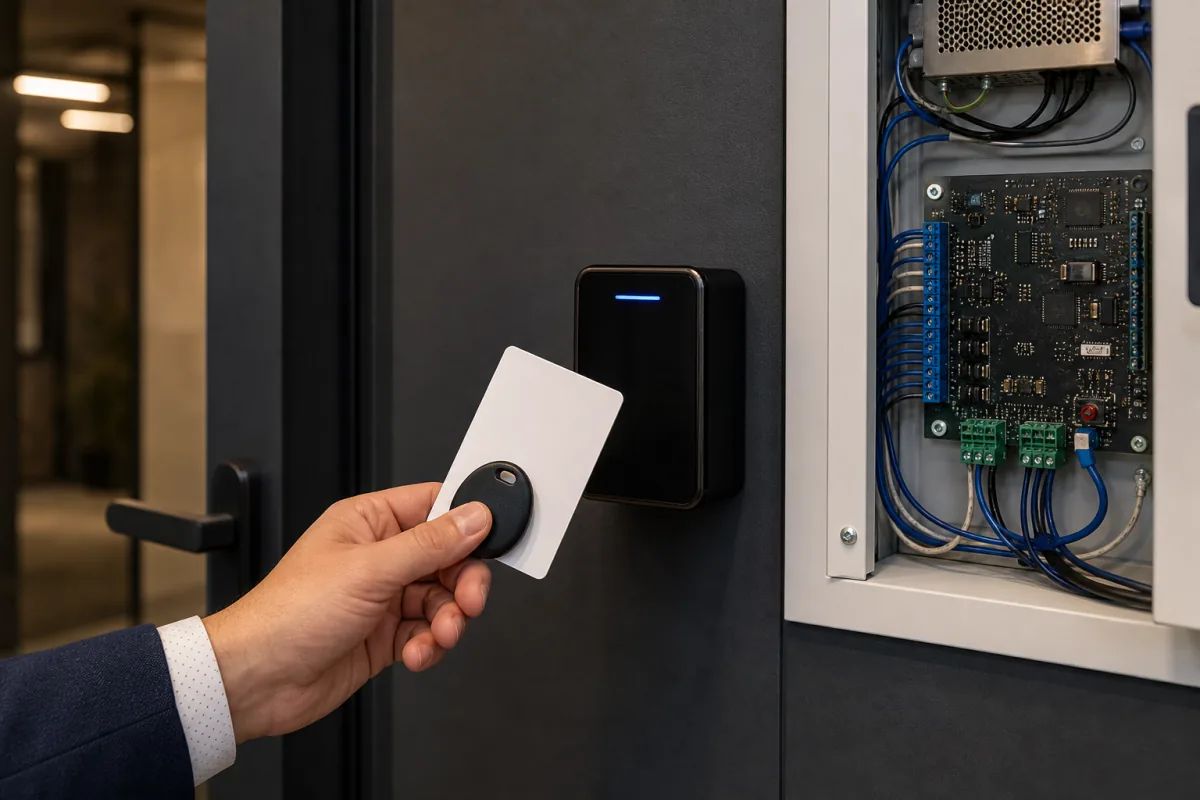
If you manage a building on a Kantech EntraPass system and need to replace access cards without going through a Johnson Controls authorized dealer, American Key Cards supplies ioProx-compatible clamshell cards and key tags directly — programmed to your site code, no dealer account required. The Kantech ioProx format operates at 125 kHz using a dual-encoded credential that carries both Kantech’s proprietary XSF format and standard 26-bit Wiegand, making it readable on ioProx-native readers and any Wiegand-compatible panel.
What Is the Kantech ioProx Format?
The Kantech ioProx format is a 125 kHz passive proximity credential developed by Kantech, now part of Johnson Controls. Every ioProx card or fob is dual-encoded at the factory:
- XSF (eXtended Secure Format): Kantech’s proprietary 64-bit codebase supporting over 4 billion unique codes via a Family Code, Facility Code, and Card Number combination. This is the encoding read by ioProx-native readers.
- Standard 26-bit Wiegand (
H10301): The industry-standard format with facility code 1–255 and card number 1–65,535. This encoding is read by any Wiegand-compatible panel when a non-ioProx reader is in use.
This dual-encoding is what makes ioProx credentials versatile: they work on dedicated Kantech ioProx readers in XSF mode and on generic Wiegand readers in standard 26-bit mode, all from the same physical card.
OEM Kantech ioProx Part Numbers
Kantech distributes ioProx credentials through its authorized dealer and distributor network. The OEM line covers several form factors:
| OEM Part Number | Form Factor | Notes |
|---|---|---|
P10SHL | Clamshell proximity card | Most common; non-printable ISO clamshell |
P20WLM | Slimline key tag | Compact wallet or keyring tag |
P20DYE | Printable ISO card | Dye-sublimation printable surface |
P30DMG | Printable ISO card (alt) | Alternate printable PVC card |
P40KEY | Standard key fob | Classic keyring proximity fob |
P50DMG | Rugged key fob | Heavier-duty fob variant |
American Key Cards produces compatible versions of the P10SHL clamshell and P40KEY key fob form factors. Our cards use the same XSF and 26-bit dual-encoding at 125 kHz and carry the same facility code and card number range you specify when ordering. We are not affiliated with Kantech or Johnson Controls — our cards are compatible by specification, not OEM product.
Which Readers Use the Kantech ioProx Format?
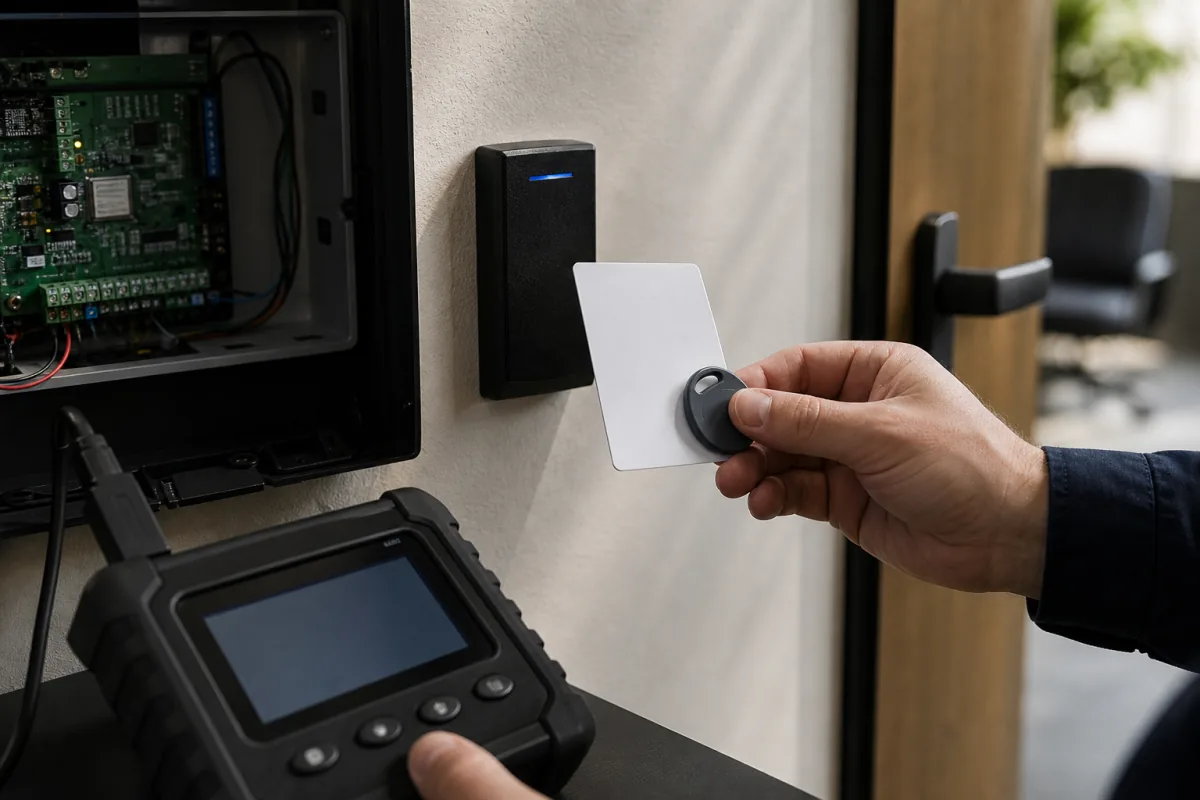
ioProx credentials are used across the Kantech ioProx reader family, which is commonly deployed in commercial offices, multi-tenant residential buildings, and institutional facilities running EntraPass software:
- Kantech
P225/P225KP— ioProx mullion reader, read range up to 6.5 inches - Kantech
P325/P325KPXSF— single-gang ioProx reader, read range up to 8.2 inches - Kantech
P600— long-range ioProx reader, read range up to 29 inches when card is presented parallel to the reader face
All of these readers decode the XSF encoding from the card. If your building uses standard Wiegand readers from other manufacturers connected to a Kantech EntraPass panel, the same ioProx card will present its 26-bit Wiegand encoding to those readers.
If you are not certain which reader is installed at your doors, check the reader housing for the Kantech logo and one of the model numbers listed above. Your installer’s commissioning records will also identify the reader model.
How ioProx Compares to Related Formats
Kantech ioProx is often confused with standard HID 26-bit or AWID-format cards because all three operate at 125 kHz and all three output 26-bit Wiegand data to the access panel. The difference is at the reader level.
| Property | Kantech ioProx (XSF) | Standard HID H10301 | AWID 26-Bit |
|---|---|---|---|
| Frequency | 125 kHz | 125 kHz | 125 kHz |
| Proprietary encoding | XSF (Kantech) | HID proprietary | AWID proprietary |
| Standard 26-bit also encoded | Yes (dual) | No | No |
| Bit format to panel | XSF or 26-bit Wiegand | 26-bit Wiegand | 26-bit Wiegand |
| Works in ioProx reader | Yes | No | No |
| Works in HID ProxPro reader | Via 26-bit only | Yes | No |
| Cloneable | Yes | Yes | Yes |
An HID ProxCard II will not be read by a Kantech P325 reader. An AWID card will not be read by a Kantech reader. You need ioProx-format credentials for ioProx readers, and that is the gap American Key Cards fills.
For background on the related formats, see our guides to the standard HID H10301 format and AWID 26-bit credentials.
Can Kantech ioProx Cards Be Cloned?
Yes. ioProx credentials operate at 125 kHz without any cryptographic protection layer. The XSF encoding provides a larger code space than standard 26-bit — over 4 billion unique codes compared to roughly 16.7 million in 26-bit — but that code space is not protected by encryption. A card’s Family Code, Facility Code, and Card Number can be read with commercially available RFID tools such as Proxmark3, and the data can be written to a blank T5577 chip that will present identically to the original card in a Kantech ioProx reader.
This is the same security posture as any other 125 kHz proximity format. For a fuller treatment of the copying question on this specific credential, see can Kantech ioProx cards be cloned?. For building environments where clone-resistant credentials matter — data centers, high-security government offices, financial operations floors — Kantech’s infrastructure also supports 13.56 MHz smart card readers, which require cryptographic authentication and cannot be cloned with commodity tools.
For the vast majority of commercial office buildings, multi-tenant residential properties, and institutional facilities, 125 kHz ioProx remains the installed standard and functions as intended for conventional access control.
Why Kantech ioProx Cards Are Hard to Source Outside Dealer Channels
Johnson Controls channels Kantech products — including ioProx credentials — through its authorized distributor and dealer network. That network exists to support system integrators, not end users. Property managers and building owners who need a batch of replacement cards for employees or tenants typically encounter one or more of the following friction points:
- Dealer account required. Many distributors will not sell Kantech credentials without an established dealer account.
- Minimum order quantities. OEM orders for
P10SHLcards commonly require 50 or more units per order — impractical for small-batch replacements. - Dealer markup. Each step in the distribution chain adds margin, so the per-card price through a dealer is significantly higher than the card’s production cost.
None of these constraints are technical. The ioProx format is a 125 kHz proximity credential — the same underlying technology as dozens of other formats. Any supplier with the ability to encode both XSF and 26-bit Wiegand onto a 125 kHz IC can produce a functionally identical card. That is precisely what American Key Cards does.
What to Have Ready Before Ordering
To order ioProx-compatible cards programmed to your system, you will need:
- Facility Code — the site-level identifier shared by all cards at your location (used in both XSF and 26-bit encoding)
- Family Code — required for XSF-mode operation on ioProx-native readers (this is a Kantech-specific parameter; check your installer records or existing card label)
- Card number or range — the individual card numbers to program (1 through the XSF maximum for XSF systems, or 1–65,535 for 26-bit only)
- Quantity and form factor — clamshell cards (P10SHL style) or key fobs (P40KEY style)
- Labeling requirements — whether the card number and facility code should be printed on the card face
If you cannot locate your facility code or Family Code, our guide on how to find your facility code covers reading the card label, pulling the value from EntraPass, and checking installer records — or contact us and we can walk through the options before your order is placed.
Compatible by Specification, Not Affiliated with Kantech
American Key Cards is an independent supplier. We have no affiliation with Kantech, Johnson Controls, or their authorized dealer network. Our ioProx-compatible cards are produced to the specification of the ioProx format — the same 125 kHz frequency, the same XSF and 26-bit dual-encoding, and the same Wiegand data output your EntraPass system expects.
When one of our cards is presented to a Kantech P325 reader, the reader decodes the XSF format and passes the credential data to the EntraPass panel exactly as it would with an OEM P10SHL card. The reader has no mechanism to distinguish OEM from compatible-by-specification. The system grants or denies access based on whether the credential’s encoded numbers match an authorized entry in the system — nothing more.
This is the same reason that compatible cards cost less: there is no proprietary encoding key, no firmware signature, and no license fee embedded in the credential itself. The cost savings come from direct distribution, not from cutting corners on the encoding.
Ready to Order Kantech ioProx Compatible Cards?
Whether you need a single replacement for a lost card or a batch of programmed credentials for a new cohort of tenants, American Key Cards can ship ioProx-compatible clamshell cards and key fobs directly to you. Have your facility code, Family Code, and card number range ready, and contact us to request a quote or place an order. We also supply credentials for related formats including standard 26-bit HID-compatible cards and AWID 26-bit cards if your property has mixed readers across different access points.
Frequently asked questions
Are compatible ioProx cards fully interchangeable with OEM Kantech cards on an EntraPass system?
Yes. Our ioProx-compatible cards are dual-encoded with both the Kantech XSF format and standard 26-bit Wiegand, identical to OEM P10SHL cards. They enroll in EntraPass the same way, read on the same P225, P325, and P600 readers, and can be mixed with existing OEM cards on the same system provided the site code matches your existing credential database.
What information do I need before ordering Kantech ioProx replacement cards?
You need your facility code and the card number range you want programmed. For XSF-format systems you may also need a Family Code. Both values are typically printed on your existing cards, available from the original installer's records, or readable from an existing card using an RFID tool. Contact us if you need help locating your site code before ordering.
Can Kantech ioProx cards be cloned or copied?
Yes. Like all 125 kHz proximity credentials, ioProx cards operate without encryption and can be copied using commercially available RFID tools such as Proxmark3 and T5577 blank cards. The XSF dual-encoding provides a larger code space than standard 26-bit but adds no cryptographic protection. For environments requiring clone-resistant credentials, Kantech also supports 13.56 MHz smart card readers.
What is the difference between the XSF format and standard 26-bit Wiegand on a Kantech card?
XSF (eXtended Secure Format) is Kantech's proprietary encoding that supports over 4 billion unique codes using a combination of Family Code, Facility Code, and Card Number. Standard 26-bit Wiegand (H10301) is limited to 255 facility codes and 65,535 card numbers per site. Every ioProx credential carries both encodings simultaneously, so it works on both ioProx-native readers using XSF and standard Wiegand readers using the 26-bit output.