Non-OEM vs. OEM Proximity Cards: Is Compatible the Same as Genuine?
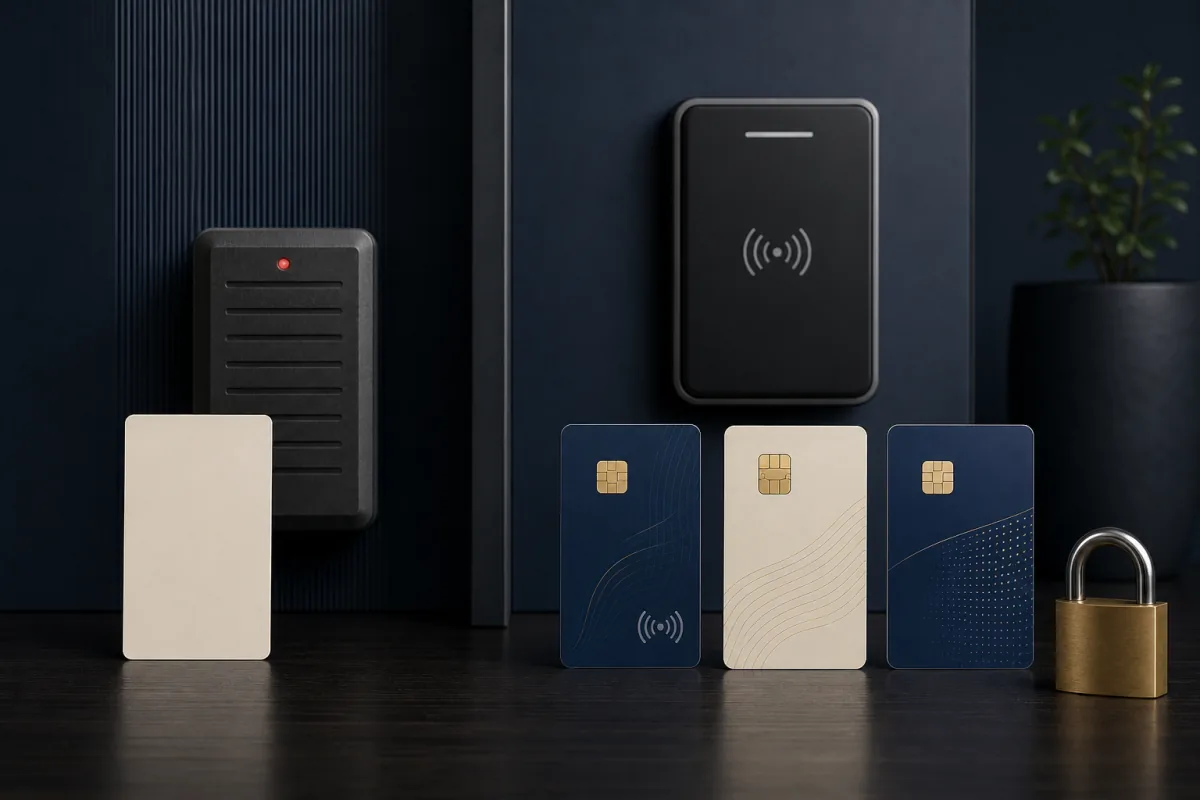
A compatible access card and an OEM-branded card are functionally the same thing in every scenario where the format is an open, reproducible specification — same frequency, same bit format, same facility code, same read range. American Key Cards supplies compatible proximity credentials programmed by specification, not affiliated with or licensed from the original reader manufacturers. For the most widely deployed open 125 kHz formats, there is nothing an OEM card does that a correctly programmed compatible card cannot. The exception is real and worth stating plainly: encrypted 13.56 MHz smart cards that authenticate with site-specific AES keys cannot be reproduced by any third party, and we say so.
What “OEM” Actually Means for Access Cards
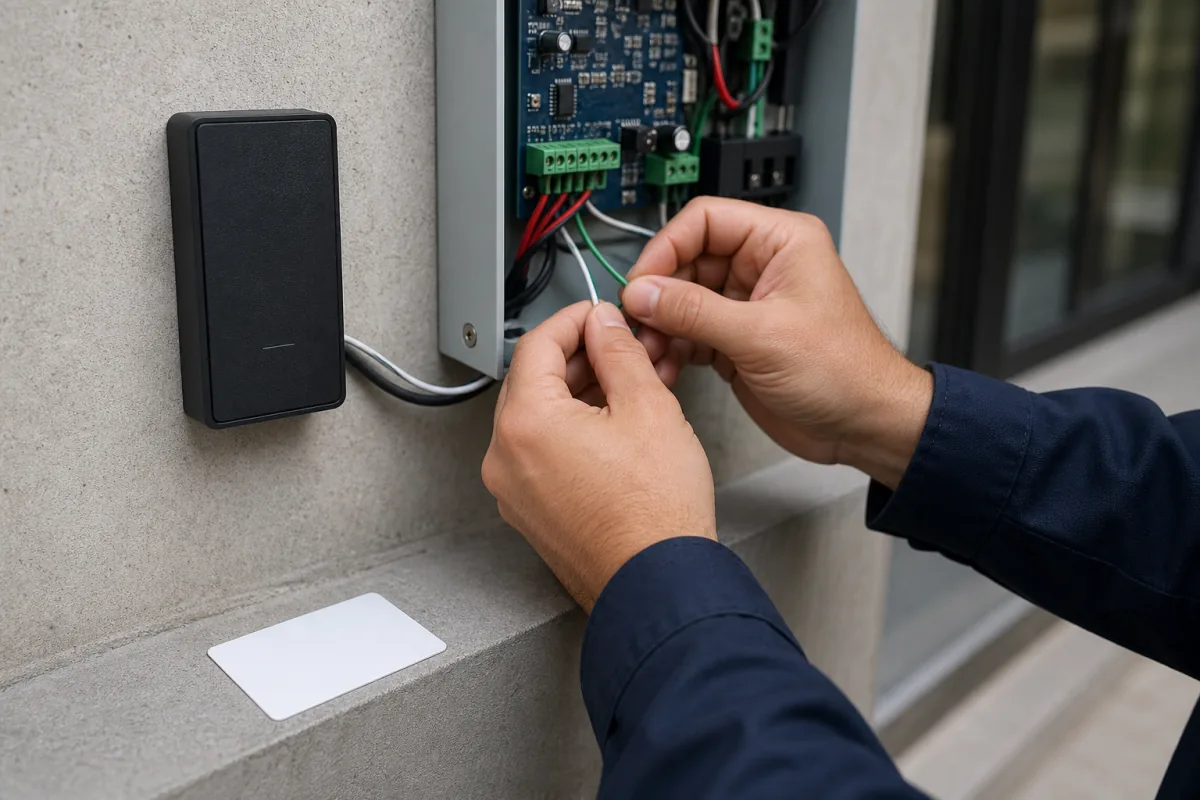
OEM — original equipment manufacturer — in the access control credential world typically refers to the brand that made the reader. A reader manufacturer sells the matching clamshell cards to go with it, usually through a dealer network. In every one of these cases, the card itself is a passive 125 kHz RFID transponder. It has no processor and runs no software. When the reader’s field energizes it, the card broadcasts a fixed data pattern — the facility code and card number — encoded in a bit format that was published or reverse-engineered into public knowledge long ago. The reader decodes that pattern and sends it to the access panel as a Wiegand output.
The OEM brand on the card body does not affect any part of that process. The reader cannot read the printing on the card — it reads the RF signal.
How Compatible Cards Are Programmed
American Key Cards programs compatible credentials to your specification before shipping. You provide:
- Format — the bit structure your readers expect (e.g., standard 26-bit Wiegand
H10301, or your specific 125 kHz proximity format) - Facility code — your site-level code, typically 1–255 for 26-bit formats (if you cannot locate it, see how to find your facility code)
- Card number range — the sequential numbers for each credential in the batch
The encoding is written to the card’s transponder using the same specification the OEM uses. The resulting card transmits an RF signal the reader cannot distinguish from an OEM-produced credential carrying the same data.
This is the same principle behind compatible ink cartridges, compatible auto parts, or generic prescription drugs. The specification is what matters; the brand on the packaging is not part of the specification.
How OEM and Compatible Cards Compare, Format by Format
Whether a non-OEM card is a viable option depends entirely on the format. Open formats are fully reproducible. Encrypted formats are not.
| Format type | Frequency | Reproducible | Compatible source | Notes |
|---|---|---|---|---|
Standard 26-bit (H10301) | 125 kHz | Yes | Yes | Most common format in North America |
| Other 125 kHz proximity (distinct air interface) | 125 kHz | Yes | Yes | Different card-to-reader protocol — the common format will not substitute |
| Extended 125 kHz formats (33/34/36-bit) | 125 kHz | Yes | Yes | Larger code space; fewer suppliers stock them |
| Standard 13.56 MHz smart card | 13.56 MHz | Yes (with limitations) | Yes | Legacy cipher; sector-key exposure required; degraded security |
| Encrypted 13.56 MHz smart card | 13.56 MHz | No | No | AES mutual authentication; not practically cloneable, site keys required |
The table reflects a factual boundary: open proximity formats are reproducible by specification. Formats with site-specific cryptographic keys are not. A buyer who needs the latter must go through the OEM or an authorized integrator — and any supplier who claims otherwise is misleading them.
Why OEM Proximity Cards Cost More
The price premium on OEM proximity credentials reflects distribution structure, not production cost.
Reader manufacturers sell through a network of authorized distributors and integrators. Access to OEM pricing typically requires a dealer account, a project registration, and a minimum order quantity. The markup at each step of the chain — distributor, integrator, end customer — is real. A property manager who needs twelve replacement cards for a tenant move-in is often quoted a price that reflects a 50-unit minimum and a distributor margin.
The physical card in the OEM clamshell is a commodity: a 125 kHz RFID transponder bonded to a PVC shell, produced at scale on the same automated equipment used across the access control industry. The production cost per card for a standard 26-bit H10301 clamshell is minimal. The OEM price reflects the brand, the distribution channel, and the sales model — not a fundamentally superior product.
What You Actually Give Up with a Compatible Card
For open 125 kHz formats, the honest answer is: almost nothing that affects system function.
You do not give up: read range, Wiegand output accuracy, compatibility with your readers, durability appropriate to normal use, or the ability to enroll the card in your access control software.
You do give up: the brand name on the card body, packaging that matches existing cards, and — if it matters to your procurement process — a certificate of origin from the OEM.
One genuine consideration: some high-security facilities have procurement policies that require OEM-sourced credentials for audit purposes. If your organization has such a policy, it applies regardless of technical equivalence. Compatible cards are appropriate for facilities where the policy permits compatible-by-specification sourcing.
For the security question specifically: a 125 kHz proximity card, OEM or compatible, provides the same level of security — which is to say, relatively low by modern standards. The card can be physically cloned with inexpensive commercially available tools regardless of who made it. If your threat model requires clone-resistant credentials, the answer is a format upgrade to 13.56 MHz smart card technology, not sourcing an OEM clamshell card.
How to Confirm Your Format Before Ordering
Before ordering any compatible card, confirm your format. The most reliable methods:
- Read the existing card. Most OEM proximity cards have the facility code and card number printed on the card face, and often a part number that identifies the format — our walkthrough on how to identify your access card format covers the markings to look for.
- Check the reader model. The reader housing usually has a model number that identifies the format. A standard proximity reader reads standard 26-bit cards; a gate reader may use a distinct 125 kHz air interface that requires a matching credential.
- Contact your original installer. The system installer’s documentation will specify the format and, ideally, the facility code.
If none of those options are available, contact us with the reader brand and model and we can help confirm the format.
The Honest Limit — Encrypted Smart Card Formats
A non-OEM supplier who claims they can produce compatible encrypted 13.56 MHz smart cards with your active site key is either mistaken or not being straight with you.
These formats use cryptographic mutual authentication. The reader challenges the card, the card must respond with a value that proves it holds the correct secret key, and the reader rejects any card that cannot provide that proof. Without the site-specific key — held only by the authorized issuer — there is no credential to produce. Blank chips are available; working credentials are not.
American Key Cards does not offer these formats. If you ask us about encrypted smart card replacements, we will tell you directly that you need to go through your integrator and the OEM issuance process.
For those formats, the OEM channel is the only channel, and that is a technically accurate statement, not a sales objection.
Ordering Compatible Proximity Cards
For open 125 kHz formats — and they represent the large majority of proximity credentials deployed across North American commercial buildings, apartment complexes, parking facilities, and campuses — a compatible card programmed to your specification is a direct functional equivalent to the OEM credential at a lower cost with no minimum order requirements.
Provide your facility code, card number range, format, and preferred form factor and American Key Cards will ship programmed credentials ready for enrollment. Contact us here to start the process.
Frequently asked questions
Are non-OEM proximity cards as reliable as OEM cards?
For open 125 kHz formats such as standard 26-bit Wiegand (H10301), a compatible card programmed to the correct facility code and bit format will read identically to an OEM card in the same reader. The reader has no way to distinguish a brand-marked card from a compatible one — it reads the encoded data, not the packaging. Physical durability varies by supplier; reputable aftermarket vendors use the same PVC clamshell and ISO card stock grades used in OEM production.
Will a non-OEM card work with my specific access control reader?
Compatibility depends on the format, not the brand. If your reader uses a standard open format — standard 26-bit Wiegand (H10301) and most other 125 kHz proximity formats — a compatible card programmed to that format and your facility code will work. If your system uses encrypted 13.56 MHz smart cards that authenticate with AES keys, those credentials cannot be reproduced by any third party and must come from the original issuer.
What information do I need to order non-OEM proximity cards?
You need your facility code, the card number range you want programmed, the format (standard 26-bit H10301 or your specific 125 kHz format), and the form factor (clamshell, ISO PVC, key fob). Your existing cards usually have the facility code and card number printed on them. If you are unsure of your format, the reader brand and model number is usually sufficient to confirm it.
Are there access card formats that genuinely cannot be sourced from non-OEM suppliers?
Yes. Encrypted 13.56 MHz smart cards that use cryptographic mutual authentication between card and reader cannot be reproduced without the site-specific keys. Without those keys, no third party can produce a functional credential — the reader will reject it. American Key Cards does not offer these formats and will tell you so directly rather than sell you cards that will not work.